Build ultra-fast In-Memory Database Apps and Microservices with Java
Is your ORM the real bottleneck? See how Java-native persistence queries data directly in RAM, making your microservices up to 1000x faster.
#1about 4 minutes
The challenge of real-time data in modern applications
Modern applications for AI, IoT, and machine learning require processing vast amounts of data in real-time, questioning if traditional Java and databases are fast enough.
#2about 5 minutes
How cloud architecture evolved from monoliths to microservices
The industry shifted from monolithic applications on physical servers to containerized microservices orchestrated by platforms like Kubernetes.
#3about 7 minutes
Java's adaptation for cloud-native and serverless computing
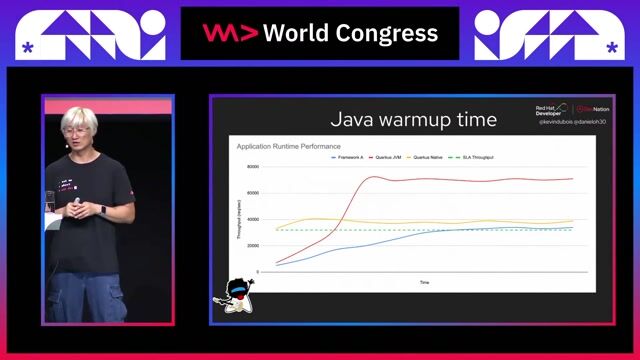
Java became suitable for microservices through lightweight frameworks, GraalVM native images for fast startups, and serverless function platforms.
#4about 8 minutes
The object-relational impedance mismatch in persistence
Storing complex Java object graphs in relational or NoSQL databases creates an impedance mismatch, requiring costly data conversion and mapping for every operation.
#5about 7 minutes
Introducing the system prevalence pattern with MicroStream
The system prevalence pattern keeps the entire application state in memory for ultra-fast queries and uses snapshots for persistence, a concept implemented by MicroStream.
#6about 7 minutes
Exploring the MicroStream persistence engine architecture
MicroStream is a Java-native persistence library that serializes object subgraphs to various storage backends without mapping, supporting lazy loading and class versioning.
#7about 5 minutes
MicroStream usage patterns, limitations, and benefits
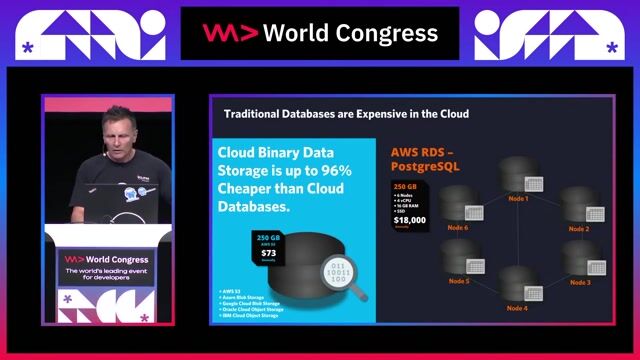
MicroStream operates as a single-node storage solution within the JVM process, offering significant performance gains and cost savings but does not use SQL.
#8about 1 minute
Combining persistence strategies in a microservices world
Microservice architectures allow you to choose the best persistence technology for each service, enabling combinations of MicroStream with relational databases or search engines.
Related jobs
Jobs that call for the skills explored in this talk.
Matching moments
02:46 MIN
Using Java's native power for high-speed data processing
Databaseless Data Processing - High-Performance for Cloud-Native Apps and AI
04:26 MIN
A new paradigm: Database-less processing and system prevalence
In-Memory Computing - The Big Picture
02:07 MIN
Using Quarkus and GraalVM for fast Java startup
Serverless Java in Action: Cloud Agnostic Design Patterns and Tips
07:13 MIN
Answering questions on Micronaut and its ecosystem
Microservices with Micronaut
02:21 MIN
Solving Java's serverless challenges with Quarkus
Serverless-Native Java with Quarkus
01:00 MIN
Using MicroProfile for cloud-native Java features
2021: Familiar APIs on Kickass Runtimes #slideless
02:46 MIN
Why traditional Java frameworks are slow in the cloud
Microservices with Micronaut
03:11 MIN
Optimizing Java performance for cloud-native applications
Using Java 17 latest features in real world projectsWelcome to this issue of the WeAreDevelopers Live Talk series. This article recaps an interesting talk by Ron Veen who introduced the audience to some of the most interesting features that got added to the Java language.About the speaker:Ron is a hig...
Benedikt Bischof
Why You Shouldn’t Build a Microservice ArchitectureWelcome to this issue of the WeAreDevelopers Live Talk series. This article recaps an interesting talk by Michael Eisenbart who talks about the pros and cons of microservice architecture.About the speaker:Michael has been working for Bosch as a sof...
Chris Heilmann
All the videos of Halfstack London 2024!Last month was Halfstack London, a conference about the web, JavaScript and half a dozen other things. We were there to deliver a talk, but also to record all the sessions and we're happy to share them with you. It took a bit as we had to wait for th...
Chris Heilmann
Micro Components - a different approach to a simpler component-based webThere has been a lot of heated discussion lately in the web community about component based development. One side argued that Web Components are a standard we should follow whereas others complained that they still lag behind in what frameworks offer...
From learning to earning
Jobs that call for the skills explored in this talk.






.gif?w=240&auto=compress,format)
.gif?w=240&auto=compress,format)