What if your database is the real bottleneck? See how a database-less architecture can be 1000x faster and cut cloud costs by up to 99%.
#1about 3 minutes
The critical need for performance in modern applications
Latency is a significant cost for businesses, making high-performance, in-memory computing essential for modern applications.
#2about 2 minutes
Understanding the fundamental speed of in-memory operations
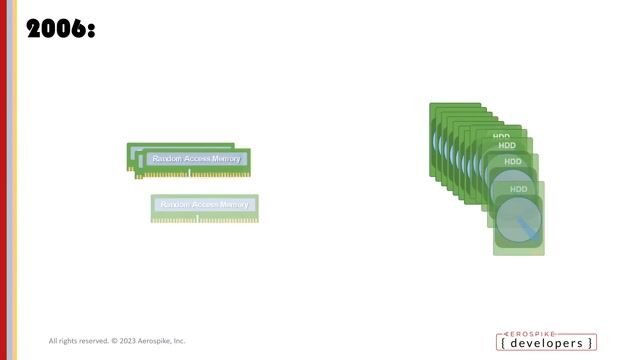
In-memory operations are orders of magnitude faster, measured in microseconds, compared to database access which is measured in milliseconds.
#3about 3 minutes
The core problem of object-relational impedance mismatch
Object-oriented programming languages are inherently incompatible with relational database models, leading to complex and slow data mapping.
#4about 3 minutes
Why NoSQL and mapping layers don't solve the bottleneck
Even with NoSQL databases, the need for data conversion and mapping layers like ORMs persists, creating a significant performance bottleneck.
#5about 3 minutes
Using distributed caches to reduce database load
A distributed cache cluster sits between the application and the database to store frequently accessed data in memory, reducing database load.
#6about 2 minutes
Differentiating in-memory data grids from distributed caches
In-memory data grids extend distributed caches by adding computational capabilities, allowing for distributed processing across the cluster.
#7about 3 minutes
The architecture and limitations of in-memory databases
In-memory databases run the DBMS in memory but often on a separate cluster, which still introduces network latency and requires data mapping.
#8about 4 minutes
A new paradigm: Database-less processing and system prevalence
The system prevalence architecture keeps the entire application state as an object graph in memory, leveraging native language APIs for ultra-fast queries.
#9about 3 minutes
Simplifying architecture and costs with Eclipse Store
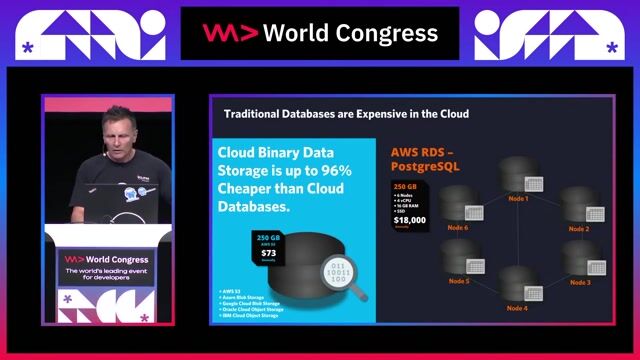
Eclipse Store provides a persistence engine that stores the in-memory object graph directly to cloud blob storage, eliminating database clusters and reducing costs.
Related jobs
Jobs that call for the skills explored in this talk.
Matching moments
02:46 MIN
Using Java's native power for high-speed data processing
Databaseless Data Processing - High-Performance for Cloud-Native Apps and AI
04:22 MIN
The challenge of real-time data in modern applications
Build ultra-fast In-Memory Database Apps and Microservices with Java
What does the history of data storage tell us about the future?In the rapidly advancing world of computing, data storage stands as a cornerstone that has evolved profoundly over the decades, adapting to meet growing demands for durability, scalability, and accessibility. From early physical storage methods to to...
Benedikt Bischof
Making Data Warehouses Fast: A Developer’s StoryWelcome to this issue of the WeAreDevelopers Live Talk series. This article recaps an interesting talk by Adnan Rahic who teaches the audience how to make data warehouses.About the Speaker: Adnan is senior developers advocate at Cube. His passion lie...
Chris Heilmann
Dev Digest 109 -Egg-citing things…As we are heading into the Easter break, here are some things to spend some time on. There's resources on improving the performance of your code and you hear from the winners of CODE100 Amsterdam what it was like to be on stage. Also, hang tight as t...
Benedikt Bischof
How we Build The Software of TomorrowWelcome to this issue of the WeAreDevelopers Live Talk series. This article recaps an interesting talk by Thomas Dohmke who introduced us to the future of AI – coding.This is how Thomas describes himself:I am the CEO of GitHub and drive the company’s...
From learning to earning
Jobs that call for the skills explored in this talk.




.gif?w=240&auto=compress,format)