What if your Java microservices could start in 67 milliseconds? See how Micronaut's compile-time magic makes the JVM a top contender for serverless.
#1about 3 minutes
Why traditional Java frameworks are slow in the cloud
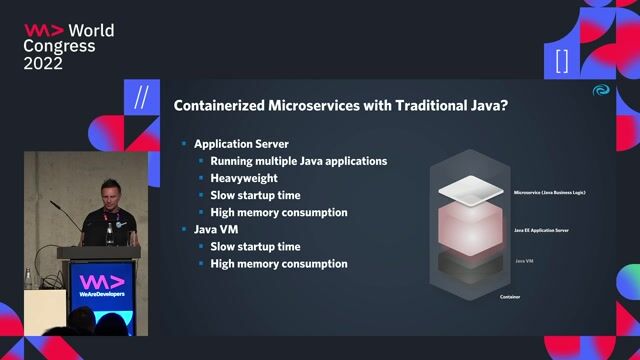
Slow startup times in frameworks like Spring Boot become a major cost and performance issue when scaling services to zero in the cloud.
#2about 3 minutes
How Micronaut achieves fast startups with compile-time DI
Micronaut moves expensive runtime operations like dependency injection, proxy creation, and AOP to the build phase using an annotation processor.
#3about 5 minutes
Understanding Micronaut's performance and build time tradeoffs
A simple benchmark with empty beans can be misleading; the real performance gains come from avoiding Spring's complex auto-configuration, at the cost of longer compile times.
#4about 5 minutes
A comprehensive overview of Micronaut's features
Micronaut is a full-stack framework providing features for dependency injection, REST APIs, caching, resilience, database access, security, and serverless functions.
#5about 5 minutes
Creating your first Micronaut project and HTTP endpoint
Bootstrap a new application using the Micronaut CLI and create a basic REST endpoint with the `@Controller` and `@Get` annotations.
#6about 4 minutes
Using dependency injection with services and singletons
Structure your application by creating services and using constructor injection with `@Inject`, ensuring implementations are discoverable with `@Singleton`.
#7about 3 minutes
Building a declarative HTTP client to call external APIs
Define a Java interface annotated with `@Client` to have Micronaut automatically generate a type-safe HTTP client implementation at compile time.
#8about 3 minutes
Implementing resilience patterns like caching and fallbacks
Easily add resilience to your services by using the `@Cacheable` annotation for caching and the `@Fallback` annotation for failure recovery.
#9about 4 minutes
Comparing Micronaut and Spring Boot performance benchmarks
A real-world application benchmark shows Micronaut has significantly faster startup times, smaller JAR sizes, and higher request throughput compared to an equivalent Spring Boot application.
#10about 4 minutes
Compiling Micronaut applications to native images with GraalVM
Leverage Micronaut's reflection-free architecture to compile your application into a native executable using GraalVM, achieving startup times under 100 milliseconds.
#11about 4 minutes
Evaluating the pros, cons, and caveats of Micronaut
While Micronaut offers impressive performance, consider its relative maturity and the complexities of debugging native images when deciding if it's right for your project.
#12about 7 minutes
Answering questions on Micronaut and its ecosystem
The speaker answers audience questions regarding OpenJDK compatibility, Spring AOP support, use cases to avoid, comparisons to Quarkus, and market adoption.
Related jobs
Jobs that call for the skills explored in this talk.
Matching moments
07:05 MIN
Java's adaptation for cloud-native and serverless computing
Build ultra-fast In-Memory Database Apps and Microservices with Java
00:56 MIN
Choosing a familiar Java framework for microservices
Microservices: how to get started with Spring Boot and Kubernetes
02:07 MIN
Using Quarkus and GraalVM for fast Java startup
Serverless Java in Action: Cloud Agnostic Design Patterns and Tips
03:11 MIN
Optimizing Java performance for cloud-native applications
Cloud Chaos and Microservices Mayhem
02:21 MIN
Solving Java's serverless challenges with Quarkus
Serverless-Native Java with Quarkus
04:20 MIN
Measuring the performance gains of a Spring native image
Going serverless using the Spring Framework ecosystem
10:25 MIN
Understanding and building GraalVM native images
Bootiful Spring Boot 3
02:33 MIN
Applying WebAssembly to solve serverless performance issues
Why You Shouldn’t Build a Microservice ArchitectureWelcome to this issue of the WeAreDevelopers Live Talk series. This article recaps an interesting talk by Michael Eisenbart who talks about the pros and cons of microservice architecture.About the speaker:Michael has been working for Bosch as a sof...
Chris Heilmann
Micro Components - a different approach to a simpler component-based webThere has been a lot of heated discussion lately in the web community about component based development. One side argued that Web Components are a standard we should follow whereas others complained that they still lag behind in what frameworks offer...
Benedikt Bischof
Using Java 17 latest features in real world projectsWelcome to this issue of the WeAreDevelopers Live Talk series. This article recaps an interesting talk by Ron Veen who introduced the audience to some of the most interesting features that got added to the Java language.About the speaker:Ron is a hig...
Chris Heilmann
Dev Digest 109 -Egg-citing things…As we are heading into the Easter break, here are some things to spend some time on. There's resources on improving the performance of your code and you hear from the winners of CODE100 Amsterdam what it was like to be on stage. Also, hang tight as t...
From learning to earning
Jobs that call for the skills explored in this talk.






.gif?w=240&auto=compress,format)

.gif?w=240&auto=compress,format)