Is reactive the new black? Imperative vs. reactive programming with Quarkus
Stop choosing between imperative and reactive. Learn how Quarkus lets you write standard code while gaining non-blocking performance benefits.
#1about 2 minutes
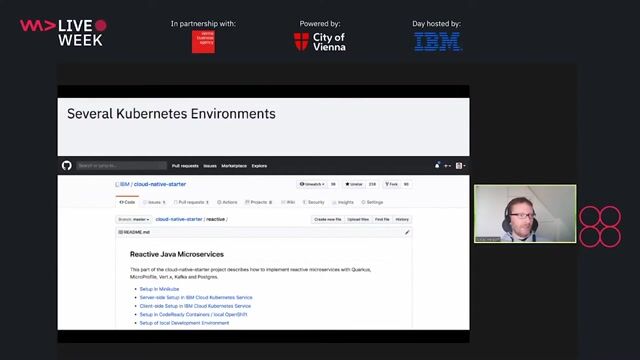
Discovering reactive programming through a modern Quarkus project
A real-world project using Quarkus and a modern tech stack serves as the motivation for exploring the challenges and benefits of reactive programming.
#2about 1 minute
Examining the trend and debate around reactive programming
Reactive programming is a growing trend seen in conference talks and online forums, but developers hold opposing views on its complexity and practical adoption.
#3about 2 minutes
Contrasting imperative, declarative, and reactive code styles
Reactive programming is a form of declarative dataflow programming that focuses on 'what' to do, differing from the step-by-step 'how' of imperative code.
#4about 2 minutes
Meeting modern application demands with the Reactive Manifesto
The Reactive Manifesto outlines the principles of responsive, resilient, elastic, and message-driven systems needed to handle today's high-concurrency and large-scale data requirements.
#5about 4 minutes
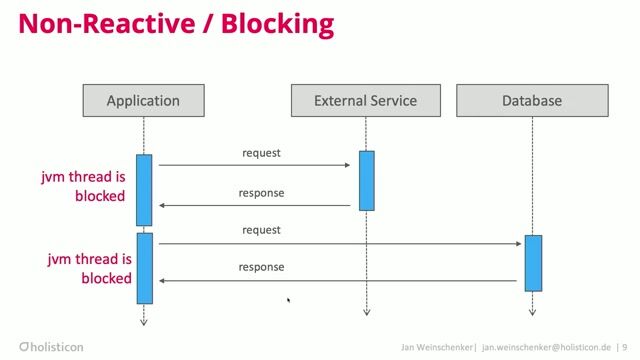
Understanding blocking vs non-blocking I/O for requests
The imperative model uses a blocking thread-per-request approach, while the reactive model uses a non-blocking event loop to handle many concurrent requests with few threads.
#6about 3 minutes
Treating data and user inputs as asynchronous streams
In reactive programming, everything from variables to user inputs can be treated as an asynchronous stream of events, which can emit values, failures, or a completion signal.
#7about 4 minutes
Managing data flow with the backpressure mechanism
Backpressure is a key reactive concept where the consumer controls the data flow by signaling to the publisher how many items it is ready to process, preventing overload.
#8about 2 minutes
Deconstructing a reactive stream pipeline in Mutiny
A code walkthrough demonstrates how Mutiny's `multi` and `uni` types create and transform data streams, which only execute upon subscription.
#9about 2 minutes
Evaluating the advantages and disadvantages of reactive code
Reactive programming offers better performance and code locality but introduces challenges like a steep learning curve, a significant mindset shift, and complex debugging.
#10about 2 minutes
Identifying when to use imperative vs reactive approaches
Choose the imperative model for self-contained, CPU-intensive tasks and the reactive model for applications with high concurrency or real-time user interfaces.
#11about 1 minute
Unifying imperative and reactive code with Quarkus
Quarkus provides a hybrid model with a reactive core that allows developers to write traditional imperative code, automatically managing the execution on the appropriate thread.
#12about 2 minutes
Summarizing key takeaways and team onboarding strategies
Key lessons include aligning the programming approach with application and team needs, and effectively onboarding new developers by pairing them with experienced engineers.
Related jobs
Jobs that call for the skills explored in this talk.
Matching moments
03:03 MIN
Improving performance with reactive programming and Quarkus
Application Modernization and Rabbits
05:28 MIN
Exploring the Quarkus reactive technology stack
Development of reactive applications with Quarkus
05:38 MIN
Implementing the flow with a reactive programming stack
Maximising Cassandra's Potential: Tips on Schema, Queries, Parallel Access, and Reactive Programming
02:47 MIN
The core principles of reactive programming
Java's Project Loom & Co - the end for reactive programming?
05:27 MIN
Deploying reactive apps and key takeaways
Development of reactive applications with Quarkus
04:11 MIN
Comparing reactive and imperative code performance
Development of reactive applications with Quarkus
02:13 MIN
Exploring reactive Java frameworks and adoption challenges
Side-by-Side: Reactive vs non-reactive Java
07:31 MIN
Lessons from a hybrid reactive and blocking architecture
Panel Discussion: Responsible AI in Practice - Real-World Examples and ChallengesIntroductionIn the ever-evolving landscape of artificial intelligence, the concept of "responsible AI" has emerged as a cornerstone for ethical and practical AI implementation. During the WWC24 Panel discussion, three eminent experts—Mina, Bjorn Brin...
Anto Pranjić
5 Reasons Why Attending Conferences Matters More Than You ThinkIt only took us a global pandemic to realize that most of our daily work can be done from home. It’s kind of funny, but things that weren’t meant to be done from home in the past such as attending meetings, managing teams, and even attending events a...
Anto Pranjić
Attending Developer Events in 2023: 6 Things to Keep in MindThe past two years in the event industry have been a little bit uncertain, let’s just say it like that. Here at WeAreDevelopers, we have faced a lot of challenges over the last 24 months or so, and dare we say, we have gained a lot of experience we c...
From learning to earning
Jobs that call for the skills explored in this talk.








.jpg?w=240&auto=compress,format)