Is a complete rewrite your only option for legacy code? This talk dismantles seven common myths holding you back.
#1about 9 minutes
Viewing your IT landscape as an evolving city
The history of Alexandria illustrates how software systems, like cities, are built on existing foundations and evolve over time.
#2about 5 minutes
Why legacy code is so difficult to understand
Legacy code often fails to communicate business intent and lacks automated tests, leading to a system nobody fully comprehends.
#3about 3 minutes
How successful software outgrows its original purpose
Legacy software often becomes a victim of its own success, as its original design cannot support exponential growth or business pivots.
#4about 3 minutes
The critical problem of ownership and technical debt
A lack of clear ownership and the anti-pattern of putting technical debt in the product backlog prevents legacy systems from aligning with corporate strategy.
#5about 3 minutes
Questioning the default need for a REST API
A REST API is not a universal solution and can lead to awkward command implementations or a distributed monolith.
#6about 3 minutes
The myth that a new technology is always better
Rewriting software in a new technology often just replaces known problems with unknown ones without providing immediate business value.
#7about 4 minutes
Why you don't need to rewrite everything at once
Instead of a full rewrite, you can add new software for specific use cases and use routing to gradually replace the legacy system.
#8about 3 minutes
Moving beyond the default relational database
Embrace polyglot persistence by choosing the right data store for each use case and defining a single canonical source of truth.
#9about 4 minutes
The misconception that software migration is expensive
Migration costs are often inflated by unnecessary cleanup; focus first on making the existing code work in the new environment.
#10about 6 minutes
Why heavy abstraction is not needed in microservices
Small, self-contained systems can be rewritten easily, making extensive abstraction layers an unnecessary source of complexity.
#11about 2 minutes
How to introduce new patterns like event sourcing
New architectural patterns can be introduced incrementally for new features, building bridges to the legacy system without a full rewrite.
Related jobs
Jobs that call for the skills explored in this talk.
Matching moments
03:05 MIN
The pervasive challenge of working with legacy software
Grappling With Clunky Old Software? Start by Understanding What’s Inside!
04:24 MIN
The challenge of justifying legacy system improvements
Data Science on Software Data
05:07 MIN
How good intentions lead to broken legacy projects
Defeat that legacy monster! Guerilla refactoring with web standards
03:27 MIN
Why developers struggle to prioritize maintenance work
Coffee with Developers - Robby Russell
04:26 MIN
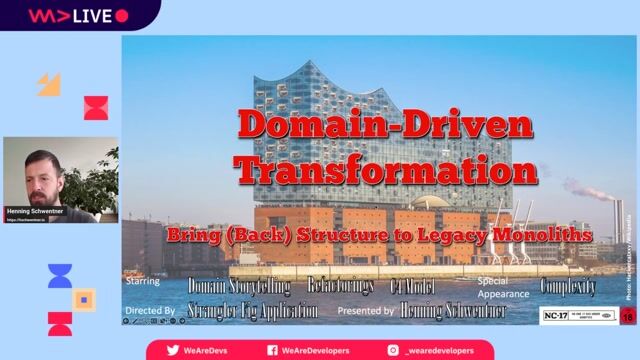
Transforming legacy systems like renovating old buildings
Domain-Driven Transformation—How to Bring (Back) Sustainable Architecture to Legacy and Monoliths
01:51 MIN
Understanding the nature of legacy project monsters
Defeat that legacy monster! Guerilla refactoring with web standards
08:14 MIN
Lessons from legacy systems and risky projects
IoT: The road to sustainability
02:29 MIN
Three core challenges in modern software development
Kalo: From Code Chaos to One-Click Polyglot Codegen
All the videos of Halfstack London 2024!Last month was Halfstack London, a conference about the web, JavaScript and half a dozen other things. We were there to deliver a talk, but also to record all the sessions and we're happy to share them with you. It took a bit as we had to wait for th...
Processing 175 WeAreDeveloper World Congress talk videos in 5 hours - with PHP?Every year after the WeAreDevelopers World Congress is over, we have a ton of video footage to edit and release. Most of it is in raw format and needs editing by hand, but a lot of our sessions are also streamed live on YouTube and thus easier to re-...
Gerry Schneider
I have a stream! Why it’s definitely worth speaking at tech conferences.Giving talks at certain events is a longed-for goal for many developers. For a good reason: it is the perfect opportunity to share your expertise and passion for a specific topic, help others learn from your mistakes, drive awareness of your solution...
From learning to earning
Jobs that call for the skills explored in this talk.