Domain-Driven Transformation—How to Bring (Back) Sustainable Architecture to Legacy and Monoliths
What if you could renovate your legacy monolith like an old building, instead of attempting a risky big-bang rewrite?
#1about 4 minutes
Transforming legacy systems like renovating old buildings
An analogy of renovating a historic warehouse into a modern concert hall illustrates the potential and challenges of software modernization.
#2about 7 minutes
Identifying common diseases in legacy software systems
Legacy systems often suffer from common architectural problems like being a "Big Ball of Mud," having an anemic domain model, or poor team organization.
#3about 4 minutes
A four-step framework for strategic transformation
A structured, four-step approach to modernization involves rediscovering the domain, modeling the target architecture, aligning it with the current state, and executing the changes.
#4about 5 minutes
Rediscovering the business domain with collaborative modeling
Use collaborative modeling techniques like Domain Storytelling to shift focus from the existing technical solution back to the core business problems and processes.
#5about 4 minutes
Defining the target architecture with bounded contexts
Use insights from domain discovery to identify sub-domains and define clear boundaries, creating a target architecture composed of distinct bounded contexts.
#6about 9 minutes
Mapping the target architecture onto the existing code
Analyze the current codebase to understand its structure and identify how to map the desired bounded contexts onto existing components, revealing shared dependencies.
#7about 5 minutes
Planning the transformation with an improvement backlog
Manage the modernization effort by creating a dedicated improvement backlog for refactoring tasks and allocating a consistent portion of sprint capacity to this work.
#8about 5 minutes
A step-by-step example of incremental refactoring
A detailed walkthrough shows how to extract a bounded context from a monolith by incrementally moving methods and classes while ensuring the system remains deployable.
#9about 3 minutes
Monolith transformation is a marathon not a sprint
The key to successful monolith transformation is recognizing it as a long-term, incremental journey that is difficult but ultimately possible with sustained effort.
#10about 15 minutes
Q&A on tools, metrics, and distributed teams
The speaker answers audience questions about using tools like ArchUnit and SonarQube, tracking KPIs, and managing distributed teams during a transformation process.
Related jobs
Jobs that call for the skills explored in this talk.
Matching moments
08:01 MIN
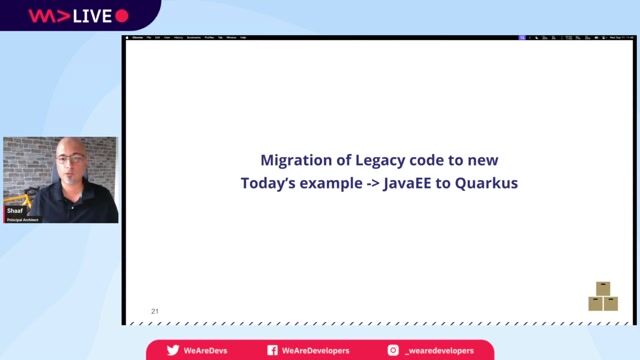
Evolving a monolith using domain-driven design
Single Server, Global Reach: Running a Worldwide Marketplace on Bare Metal in a Cloud-Dominated World
04:20 MIN
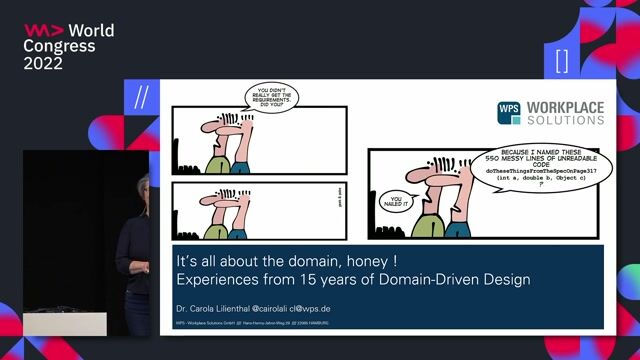
Introduction to Domain-Driven Design and sustainability
It’s all about the domain, honey ! Experiences from 15 years of Domain-Driven Design
02:49 MIN
The problem with traditional layered architectures
CQRS and Event Sourcing without the pixie dust
02:16 MIN
Understanding the scope of automated modernization
Application Modernization Leveraging Gen-AI for Automated Code Transformation
02:29 MIN
How to migrate legacy projects to a clean architecture
Building software that scales with Typescript
01:16 MIN
Viewing DDD as a holistic software engineering approach
20 Years of Domain-Driven Design: What I’ve Learned About DDD
01:15 MIN
Why incremental modernization beats a big bang rewrite
Interface Contracts in Microfrontend Architectures
03:57 MIN
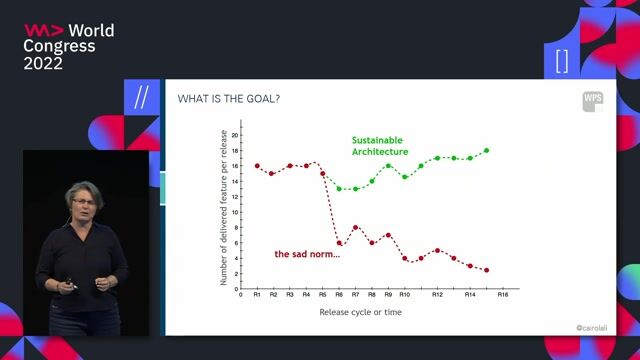
Achieving sustainable software architecture for long-term productivity
It’s all about the domain, honey ! Experiences from 15 years of Domain-Driven Design
Why You Shouldn’t Build a Microservice ArchitectureWelcome to this issue of the WeAreDevelopers Live Talk series. This article recaps an interesting talk by Michael Eisenbart who talks about the pros and cons of microservice architecture.About the speaker:Michael has been working for Bosch as a sof...
Chris Heilmann
WeAreDevelopers LIVE days are changing - get ready to take partStarting with this week's Web Dev Day edition of WeAreDevelopers LIVE Days, we changed the the way we run these online conferences. The main differences are:Shorter talks (half an hour tops)More interaction in Q&AA tips and tricks "Did you know" sect...
Benedikt Bischof
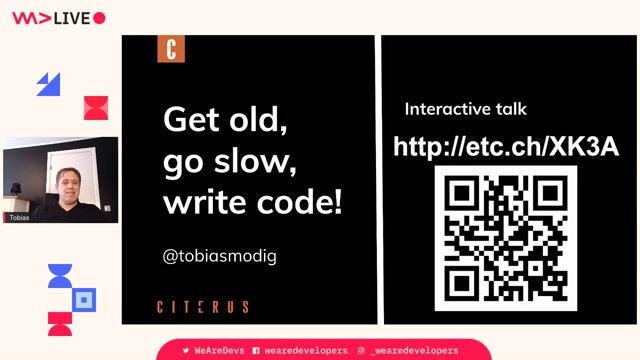
Get Old, go Slow, Write Code!Welcome to the newest series of the WeAreDevelopers Magazine – Dev Talk Recap. This article recaps an interesting talk by Tobias Modig who gave advice about getting old(er) as a developer and slowing down. What you will learn:Thoughts of the speaker ...
From learning to earning
Jobs that call for the skills explored in this talk.

.gif?w=240&auto=compress,format)

.gif?w=240&auto=compress,format)