Streaming AI Responses in Real-Time with SSE in Next.js & NestJS
Are long AI wait times hurting your app? Learn how Server-Sent Events deliver responses in under 200 milliseconds, boosting retention and cutting costs.
#1about 4 minutes
Why streaming AI responses improves user experience
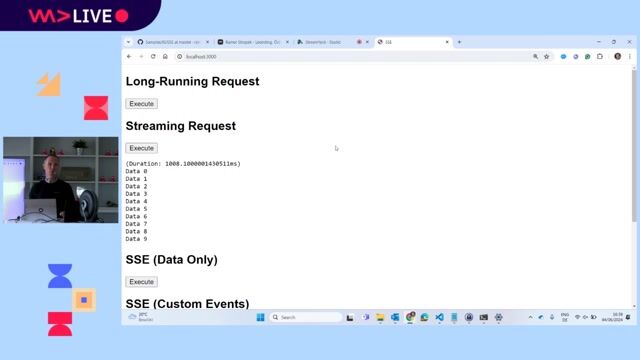
Streaming AI text token-by-token significantly improves user retention and engagement compared to showing a loading screen.
#2about 2 minutes
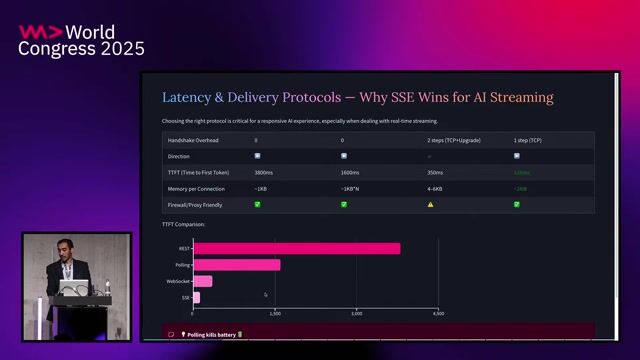
Comparing SSE, WebSockets, and polling for real-time data
Server-Sent Events (SSE) offer a lightweight, unidirectional alternative to WebSockets for pushing data, consuming half the memory per connection.
#3about 4 minutes
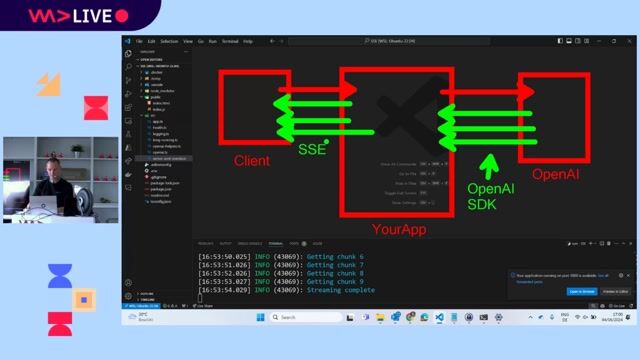
A full-stack architecture for streaming AI responses
The frontend uses the browser's EventSource API to subscribe to a NestJS backend endpoint that streams data from an AI provider.
#4about 2 minutes
Implementing an SSE endpoint in NestJS for AI streaming
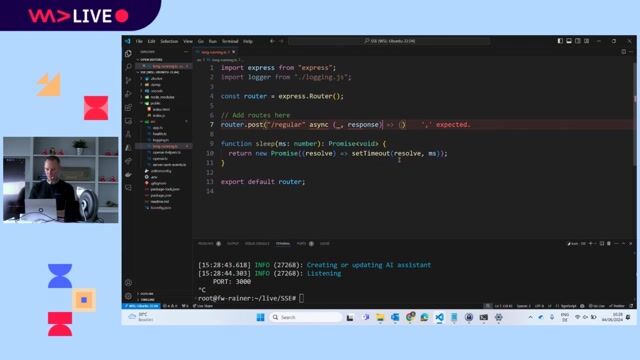
Set the `text/event-stream` content type and use a loop to push data chunks received from the OpenAI or Gemini streaming API to the client.
#5about 2 minutes
Consuming SSE streams in Next.js with EventSource
Use the native `EventSource` object to connect to the streaming endpoint and append incoming data to the component's state for a typewriter effect.
#6about 5 minutes
Using SSE for notifications and real-time file sharing
A code demonstration shows how to manage multiple client connections and push different event types, such as notifications or file data, to all subscribers.
#7about 2 minutes
Preparing an SSE implementation for production environments
Ensure reliability in production by adding authentication guards, rate limiting, keep-alive messages, and configuring proxy buffering in Nginx.
#8about 2 minutes
Scaling SSE applications for thousands of concurrent users
For large-scale applications, progress from a simple load balancer to using Redis Streams for message queuing or a dedicated SSE hub infrastructure.
#9about 2 minutes
Comparing AI providers for optimal streaming performance
AI providers like Groq, Gemini, and OpenAI differ in their streaming approach, offering either token-by-token or chunk-by-chunk responses which impacts perceived speed.
#10about 3 minutes
Syncing data from ChatGPT to multiple client applications
A custom GPT action can trigger a backend process that uses SSE to push new data in real-time to a user's browser extension, desktop, and mobile apps simultaneously.
#11about 1 minute
Understanding SSE limitations and its key benefits
Use SSE for unidirectional server-to-client data push, but choose other protocols like WebRTC for video or gRPC for microservices, to leverage its benefits of low latency and better user trust.
Related jobs
Jobs that call for the skills explored in this talk.
Matching moments
06:44 MIN
Why SSE is relevant again because of OpenAI
Leveraging Server-Sent Events (SSE) for Efficient Data Streaming in UI Development
12:24 MIN
Q&A on SSE implementation and best practices
Leveraging Server-Sent Events (SSE) for Efficient Data Streaming in UI Development
05:41 MIN
Building a streaming client for the OpenAI API
Leveraging Server-Sent Events (SSE) for Efficient Data Streaming in UI Development
05:56 MIN
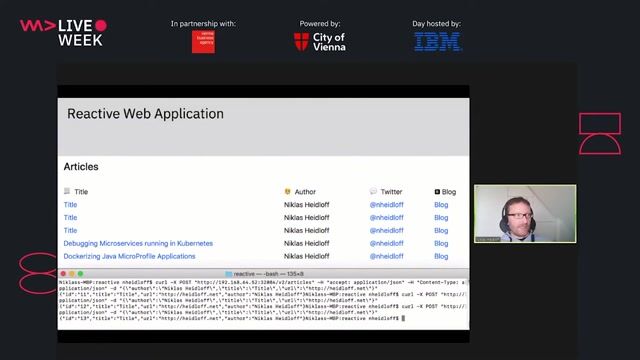
Streaming data to web clients with SSE
Development of reactive applications with Quarkus
07:19 MIN
Introducing the Server-Sent Events protocol
Leveraging Server-Sent Events (SSE) for Efficient Data Streaming in UI Development
04:18 MIN
Why modern applications adopt event streaming
Event Messaging and Streaming with Apache Pulsar
25:09 MIN
Audience Q&A on serverless IoT development
Building your way to a serverless powered IOT Buzzwire game
03:38 MIN
Answering audience questions on serverless architecture
From 0 to 1.000.000: How to build a serverless raffle service for hyperscale
Dev Digest 116 - WWWAI?This time, learn how to un-AI Google's search results, what's new on the web, avoid a new security hole and go back to BASICS with us. News and ArticlesWhat a week. Google, Microsoft, OpenAI and many others had their big flagship events announcing th...
Daniel Cranney
Panel Discussion: Responsible AI in Practice - Real-World Examples and ChallengesIntroductionIn the ever-evolving landscape of artificial intelligence, the concept of "responsible AI" has emerged as a cornerstone for ethical and practical AI implementation. During the WWC24 Panel discussion, three eminent experts—Mina, Bjorn Brin...
Chris Heilmann
WWC24 Talk - Scott Hanselman - AI: Superhero or Supervillain?Join Scott Hanselman at WWC24 to explore AI's role as a superhero or supervillain. Scott shares his 32 years of experience in software engineering, discusses AI myths, ethical dilemmas, and tech advancements. Engage with his live demos and insights o...