Prompt API & WebNN: The AI Revolution Right in Your Browser
What if you could run generative AI directly in the browser, no cloud required? Learn how new APIs unlock private, offline-first AI experiences.
#1about 3 minutes
The case for running AI models locally
Cloud-based AI has drawbacks like offline limitations, capacity issues, data privacy concerns, and subscription costs, creating an opportunity for local, on-device models.
#2about 2 minutes
Two primary approaches for browser-based AI
The W3C is exploring two main approaches for on-device AI: "Bring Your Own AI" libraries like WebLLM and low-level APIs like WebNN, alongside experimental "Built-in AI" APIs like the Prompt API.
#3about 3 minutes
Running large language models with WebLLM
The WebLLM library uses WebGPU to download and run open-weight large language models directly in the browser's cache storage, enabling offline chat and data processing.
#4about 1 minute
Solving the model size and storage problem
Large AI models create a storage problem due to browser origin isolation, leading to a proposal for a Cross Origin Storage API to allow models to be shared across different websites.
#5about 2 minutes
Exploring diverse ML workloads with Transformers.js
The Transformers.js library enables various on-device machine learning tasks beyond text generation, such as computer vision and audio processing, as shown in a sketch recognition game.
#6about 4 minutes
Accelerating performance with the WebNN API
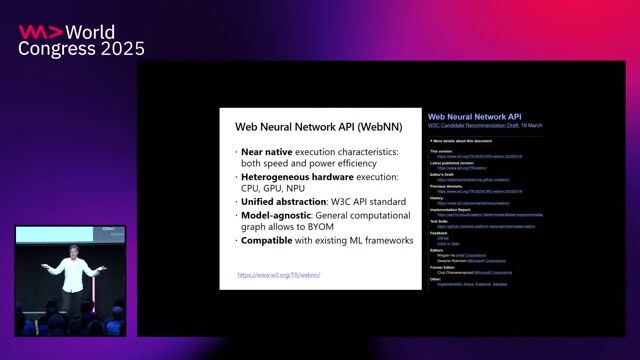
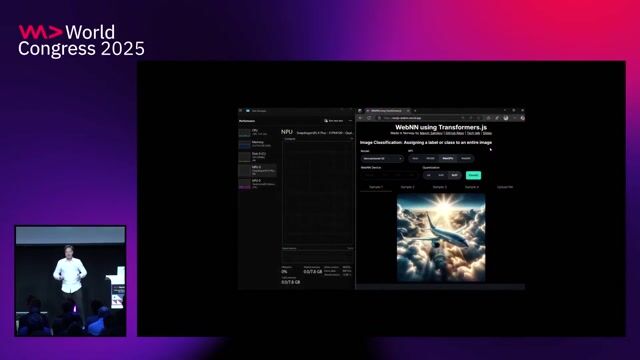
The upcoming Web Neural Network (WebNN) API provides direct access to specialized hardware like NPUs, offering a significant performance increase for ML tasks compared to CPU or GPU processing.
#7about 3 minutes
The alternative: Built-in AI and the Prompt API
Google Chrome's experimental built-in AI initiative solves model sharing and performance issues by providing standardized APIs that use a single, browser-managed model like Gemini Nano.
#8about 4 minutes
Exploring the built-in AI API suite
A demonstration of the built-in AI APIs shows how to use the summarizer, language detector, and Prompt API for general LLM tasks directly from JavaScript in the browser.
#9about 4 minutes
Practical use cases for on-device AI
On-device AI can enhance web applications with features like an offline-capable chatbot in an Angular app or a smart form filler that automatically categorizes and inputs user data.
#10about 3 minutes
Building real-time conversational agents
Demonstrations of a multimodal insurance form assistant and a simple on-device conversational agent highlight the potential for creating interactive, real-time user experiences with local AI.
#11about 1 minute
Weighing the pros and cons of on-device AI
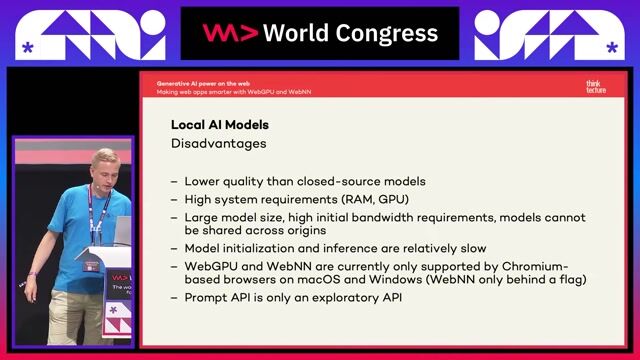
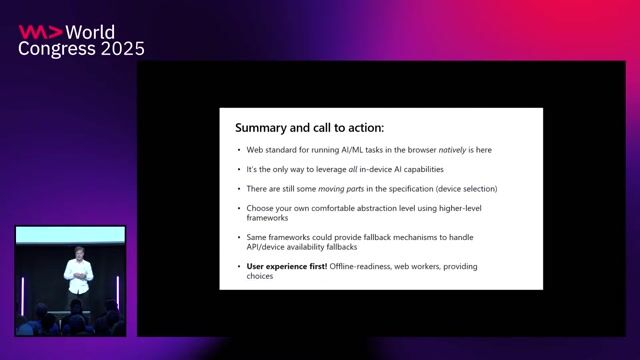
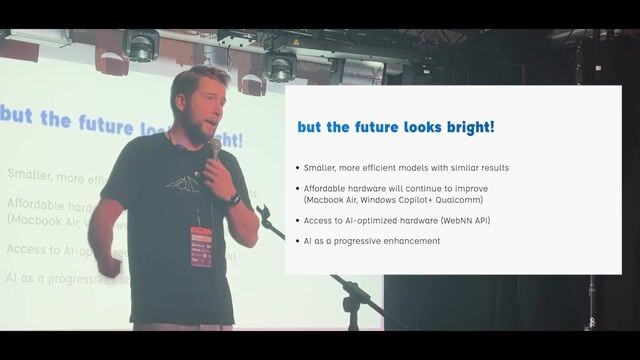
On-device AI offers significant advantages in privacy, availability, and cost, but developers must consider the trade-offs in model capability, response quality, and system requirements compared to cloud solutions.
Related jobs
Jobs that call for the skills explored in this talk.
Matching moments
03:24 MIN
Running on-device AI in the browser with Gemini Nano
Exploring Google Gemini and Generative AI
01:14 MIN
The future of on-device AI in web development
Generative AI power on the web: making web apps smarter with WebGPU and WebNN
02:08 MIN
The future of on-device AI hardware and APIs
From ML to LLM: On-device AI in the Browser
02:20 MIN
The technology behind in-browser AI execution
Generative AI power on the web: making web apps smarter with WebGPU and WebNN
03:35 MIN
Boosting performance with the upcoming WebNN API
Generative AI power on the web: making web apps smarter with WebGPU and WebNN
02:51 MIN
Introducing the Web Neural Network (WebNN) standard
Privacy-first in-browser Generative AI web apps: offline-ready, future-proof, standards-based
03:28 MIN
Best practices and the future of browser AI
Privacy-first in-browser Generative AI web apps: offline-ready, future-proof, standards-based
Dev Digest 116 - WWWAI?This time, learn how to un-AI Google's search results, what's new on the web, avoid a new security hole and go back to BASICS with us. News and ArticlesWhat a week. Google, Microsoft, OpenAI and many others had their big flagship events announcing th...
Daniel Cranney
Stephan Gillich - Bringing AI EverywhereIn the ever-evolving world of technology, AI continues to be the frontier for innovation and transformation. Stephan Gillich, from the AI Center of Excellence at Intel, dove into the subject in a recent session titled "Bringing AI Everywhere," sheddi...
Daniel Cranney
Panel Discussion: Responsible AI in Practice - Real-World Examples and ChallengesIntroductionIn the ever-evolving landscape of artificial intelligence, the concept of "responsible AI" has emerged as a cornerstone for ethical and practical AI implementation. During the WWC24 Panel discussion, three eminent experts—Mina, Bjorn Brin...
Adrien Book
How AI Will Eat The World 🤖Of generative-AI-for-everything and synthetic pleasuresRemember the web3 hype? Tech bros with easy access to cheap liquidity wanted to create a decentralised, peer-to-peer internet powered by blockchain technology. Spoiler alert, it did not work. And...
From learning to earning
Jobs that call for the skills explored in this talk.