How Gatsby Cloud's real-time streaming architecture drives <5 second builds
What if your content updates could go live in under two seconds? Discover the streaming architecture that moves beyond the limits of traditional SSG and SSR.
#1about 5 minutes
Understanding how to maintain and update derived data
HTML is a form of derived data that must be updated whenever its source content or code changes.
#2about 6 minutes
Comparing batch processing and application caching models
Batch processing is efficient for large datasets but has high latency, while application caching offers fresher data at a higher computational cost.
#3about 8 minutes
Mapping batch processing to SSG and caching to SSR
Static site generators (SSG) follow a batch processing model, while server-side rendering (SSR) uses on-demand generation with application caching.
#4about 5 minutes
Learning from database indexes and stream processing
Database indexes provide a model for maintaining derived data by reacting directly and efficiently to individual data change events.
Gatsby models the flow of data from a CMS through nodes and pages, using GraphQL to declare dependencies for automatic and precise updates.
#6about 4 minutes
Demonstrating sub-second builds with Gatsby Cloud
A live demonstration shows how Gatsby Cloud rebuilds and deploys a site in under two seconds by reacting instantly to a CMS content change.
#7about 3 minutes
Analyzing the scaling challenges of SSG and SSR
As sites grow, SSGs become too slow for updates, while SSR faces risks from traffic spikes and requires over-provisioning or serving stale data.
#8about 2 minutes
Using frameworks for automatic cache invalidation
Frameworks with first-class data models like Gatsby or Drupal can automate cache invalidation, which is faster and less error-prone than manual or TTL-based approaches.
#9about 5 minutes
Scaling Gatsby builds with vertical and horizontal scaling
Gatsby improves initial build times by first scaling vertically to use all CPU cores on one machine, and then horizontally by distributing work across multiple machines.
Related jobs
Jobs that call for the skills explored in this talk.
Matching moments
01:53 MIN
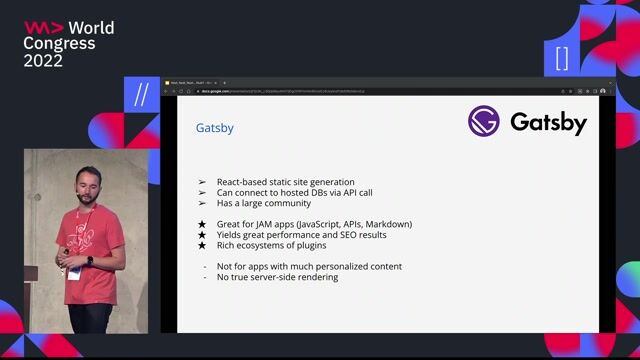
Building static sites with Gatsby and React
Next, Nest, Nuxt… Nust?
05:13 MIN
Using static site generators and Jamstack for efficiency
How Your Bundle Size Affects The Climate
04:00 MIN
Understanding Jamstack architecture and incremental static generation
How Your Bundle Size Affects The Climate
04:02 MIN
Using static site generators to pre-render markup
Jamstack and Web Performance, a match made in heaven
02:10 MIN
A developer's journey from PHP and Gatsby to Astro
One Framework To Rule Them All: Faster Websites With Astro
02:49 MIN
How static site generators deliver immediate responses
What the Heck is Edge Computing Anyway?
05:52 MIN
Exploring the advantages of decoupling your application
Decoupling 101 - Why decouple, when not to, progressive decoupling and success stories in decoupling
Dev Digest 134 - Where pixels sing?News and ArticlesWeAreDevelopers LIVE Data and Security Day is on Wednesday, 25/09/2024. Learn about OPC UA Updates, Best Practices for Using GitHub Secrets, Passwordless Web 1.5, Emerging AI Security Risks, Data Privacy in LLMs and get a chance to t...
Chris Heilmann
Dev Digest 126 - * yells at cloudHello there, during the WeAreDevelopers World Congress last week many people got stranded on their way home because of the CrowdStrike debacle. But all worked out and we will be back 2025! Tickets are already available and you can try your luck at th...
Chris Heilmann
Processing 175 WeAreDeveloper World Congress talk videos in 5 hours - with PHP?Every year after the WeAreDevelopers World Congress is over, we have a ton of video footage to edit and release. Most of it is in raw format and needs editing by hand, but a lot of our sessions are also streamed live on YouTube and thus easier to re-...