Your database is wasting modern RAM as a simple cache. Learn how a new architecture delivers predictable microsecond latency and slashes server costs.
#1about 4 minutes
The evolution of Moore's Law and its impact on software
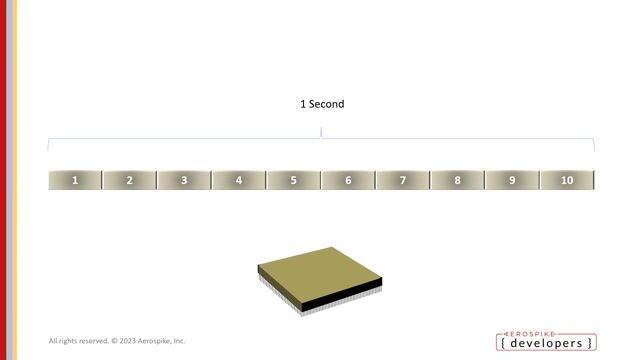
Moore's Law drove CPU speed increases until 2005, after which the industry shifted focus from single-core performance to multi-core scalability.
#2about 2 minutes
Comparing server hardware from 2006 to 2024
Modern servers have vastly more RAM and significantly faster storage compared to 2006, fundamentally changing the ratio of memory to disk.
#3about 7 minutes
Traditional database architecture and its reliance on caching
Databases designed for limited RAM now use the extra memory in modern hardware as a cache, which sits on top of the original disk-based architecture.
#4about 6 minutes
The problems and unpredictability of database caching
Caching leads to inconsistent performance across environments and fails to improve overall application latency when multiple parallel queries are involved.
#5about 4 minutes
An alternative architecture with the index in RAM
A modern database design can leverage abundant RAM to hold the entire index in memory, enabling direct, fast access to data on SSDs without a cache.
#6about 4 minutes
Achieving speed and efficiency without caching
By using fewer resources like CPU cycles and disk I/O, an index-in-RAM architecture provides consistently fast performance and reduces infrastructure costs.
Related jobs
Jobs that call for the skills explored in this talk.
Matching moments
09:31 MIN
How an in-memory caching layer enables massive scale
Single Server, Global Reach: Running a Worldwide Marketplace on Bare Metal in a Cloud-Dominated World
02:18 MIN
The database is the real bottleneck in scaling applications
Scaling Databases
05:35 MIN
Optimizing NoSQL data models for extreme speed
Leveraging Real time data in FSIs
02:01 MIN
The architectural advantage of a SQL-native design
Fault Tolerance and Consistency at Scale: Harnessing the Power of Distributed SQL Databases
07:33 MIN
Answering questions on Cube's architecture and use cases
Making Data Warehouses fast. A developer's story.
02:35 MIN
The critical need for performance in modern applications
In-Memory Computing - The Big Picture
03:07 MIN
The architecture and limitations of in-memory databases
In-Memory Computing - The Big Picture
14:47 MIN
Architectural choices for reducing your carbon footprint
An Architect’s guide to reducing the carbon footprint of your applications
What does the history of data storage tell us about the future?In the rapidly advancing world of computing, data storage stands as a cornerstone that has evolved profoundly over the decades, adapting to meet growing demands for durability, scalability, and accessibility. From early physical storage methods to to...
Chris Heilmann
Dev Digest 139 - Soft and hard queriesNews and ArticlesLet's start with Amelia Wattenberger's excellent essay Bridging the hard and the soft talking about humans and data. Do you sometimes also miss aspects of the early web like a lack of big data and freedom to create without numeric go...
Benedikt Bischof
Making Data Warehouses Fast: A Developer’s StoryWelcome to this issue of the WeAreDevelopers Live Talk series. This article recaps an interesting talk by Adnan Rahic who teaches the audience how to make data warehouses.About the Speaker: Adnan is senior developers advocate at Cube. His passion lie...
Benedikt Bischof
How we Build The Software of TomorrowWelcome to this issue of the WeAreDevelopers Live Talk series. This article recaps an interesting talk by Thomas Dohmke who introduced us to the future of AI – coding.This is how Thomas describes himself:I am the CEO of GitHub and drive the company’s...
From learning to earning
Jobs that call for the skills explored in this talk.












.gif?w=240&auto=compress,format)