Stop over-engineering your database. Learn the simple scaling patterns that can handle massive traffic before you ever need to shard.
#1about 2 minutes
The database is the real bottleneck in scaling applications
Your programming language or framework is rarely the performance problem; the database is almost always the component that limits growth.
#2about 1 minute
Optimize queries and add caching before scaling out
Before distributing your database across multiple servers, you must first fix slow queries, add proper indexes, and implement caching to avoid amplifying existing problems.
#3about 1 minute
Scaling up is the simplest and most effective first step
Instead of immediately adding complexity with multiple servers, simply upgrading your existing database server with more memory and CPU cores is a cost-effective solution.
#4about 4 minutes
Understanding the trade-offs of multi-master replication
While multi-master replication allows writes to any server and guarantees read-after-write consistency, it often suffers from performance degradation due to write conflicts on the same data.
#5about 5 minutes
Using read replication to scale read-heavy workloads
Read replication uses a single primary for writes and multiple secondaries for reads, but requires careful application design to handle asynchronous replication lag and potential stale data.
#6about 5 minutes
The power and complexity of database sharding
Sharding provides near-infinite scalability by distributing data across multiple independent databases, but introduces significant complexity like cross-shard joins and managing multiple database systems.
#7about 2 minutes
Keep your database scaling strategy as simple as possible
Avoid premature optimization by choosing the simplest scaling solution that meets your current needs, as overly complex systems are difficult to manage and can lead to costly rewrites.
Related jobs
Jobs that call for the skills explored in this talk.
Matching moments
02:59 MIN
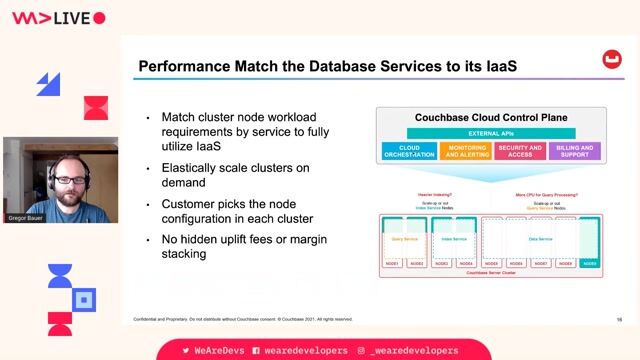
Scaling and ensuring high availability with Couchbase architecture
Database Magic behind 40 Million operations/s
02:28 MIN
Summarizing key takeaways for building hyperscale systems
From 0 to 1.000.000: How to build a serverless raffle service for hyperscale
03:35 MIN
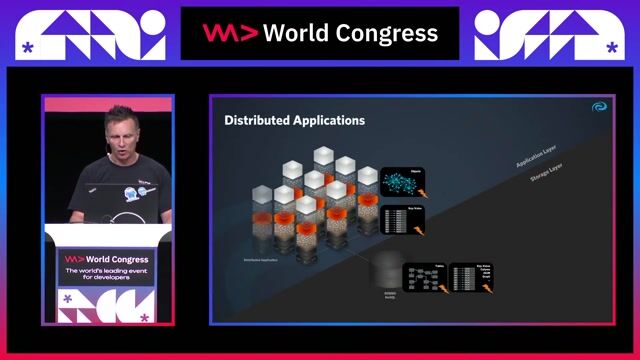
How distributed systems increase infrastructure complexity
Databaseless Data Processing - High-Performance for Cloud-Native Apps and AI
01:52 MIN
An overview of scaling a sports app to millions of users
Scaling: from 0 to 20 million users
00:56 MIN
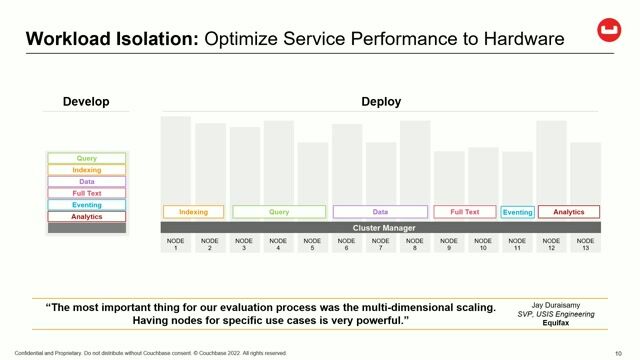
Optimizing costs with multi-dimensional scaling
Tomorrow's cloud data platforms - fully managed database-as-a-service (DBaaS)
01:07 MIN
Key design patterns for distributed database applications
Fault Tolerance and Consistency at Scale: Harnessing the Power of Distributed SQL Databases
08:41 MIN
Amazon's early monolith and database scaling challenges
Building Systems that Last
02:19 MIN
Addressing the challenges of scaling large web applications
Leveraging Storybook for Component Driven Development outside of your classic Component Library.
Making Data Warehouses Fast: A Developer’s StoryWelcome to this issue of the WeAreDevelopers Live Talk series. This article recaps an interesting talk by Adnan Rahic who teaches the audience how to make data warehouses.About the Speaker: Adnan is senior developers advocate at Cube. His passion lie...
Chris Heilmann
Dev Digest 139 - Soft and hard queriesNews and ArticlesLet's start with Amelia Wattenberger's excellent essay Bridging the hard and the soft talking about humans and data. Do you sometimes also miss aspects of the early web like a lack of big data and freedom to create without numeric go...
Benedikt Bischof
Why You Shouldn’t Build a Microservice ArchitectureWelcome to this issue of the WeAreDevelopers Live Talk series. This article recaps an interesting talk by Michael Eisenbart who talks about the pros and cons of microservice architecture.About the speaker:Michael has been working for Bosch as a sof...
Daniel Cranney
What does the history of data storage tell us about the future?In the rapidly advancing world of computing, data storage stands as a cornerstone that has evolved profoundly over the decades, adapting to meet growing demands for durability, scalability, and accessibility. From early physical storage methods to to...
From learning to earning
Jobs that call for the skills explored in this talk.






.gif?w=240&auto=compress,format)

.gif?w=240&auto=compress,format)