Your primary role as an architect isn't to find silver bullets. It's to identify the least painful option on the table.
#1about 3 minutes
Beware the faith healer and embrace trade-offs
Every technology or architectural decision comes with downsides, so an architect's job is to identify and choose the least painful option.
#2about 2 minutes
Understanding the trade-offs of using message queues
Message queues can manage fluctuating workloads and decouple services, but they introduce trade-offs like message backlogs and monitoring complexity.
#3about 3 minutes
Applying the divide and conquer principle to monoliths
Breaking down a monolith into independent services can maintain a cleaner architecture over time but introduces significant operational complexity.
#4about 1 minute
Using design patterns as a common language
Design patterns like those from the Gang of Four provide a shared vocabulary to communicate complex architectural concepts effectively.
#5about 6 minutes
Achieving loose coupling with asynchronous patterns
Use asynchronous patterns like queues and topics to reduce temporal, availability, and location dependencies between services in a distributed system.
#6about 7 minutes
Designing for failure with retries and replays
Manage inevitable system failures by implementing patterns like dead letter queues for retries, understanding the scope of deduplication, and using archive-and-replay for disaster recovery.
#7about 1 minute
Preparing for success by architecting for flexibility
Ensure your system can handle growth from a hundred to millions of users by building flexibility into all layers, not just compute.
#8about 1 minute
Don't reinvent the wheel, focus on your business
Avoid building undifferentiated infrastructure and instead leverage existing tools and industry standards to focus on features that are unique to your business.
Related jobs
Jobs that call for the skills explored in this talk.
Matching moments
01:34 MIN
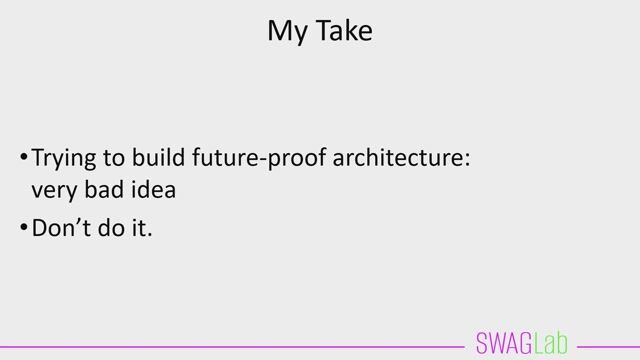
The myth of future-proof software architecture
There is no such thing as future-proof architecture! Here is how to prepare for it.
02:32 MIN
Software architecture is about evaluating consequences
Micro Frontends with Module Federation: Why and How?
02:46 MIN
Understanding critical architectural trade-offs and anti-patterns
Azure-Well Architected Framework - designing mission critical workloads in practice
02:20 MIN
The role of an architect and the need for architecture
Architectures that we can use with .NET
03:26 MIN
The primary goal of software architecture is speed
Why you shouldn’t build a microservice architecture
03:57 MIN
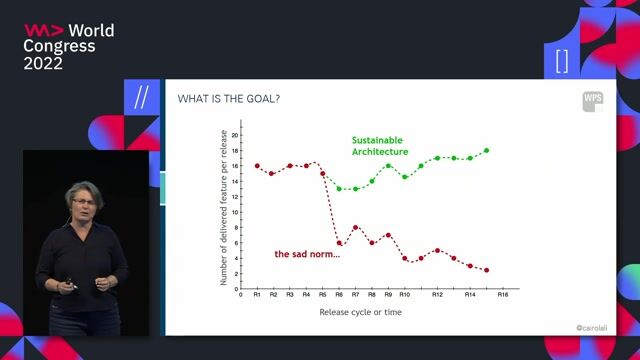
Achieving sustainable software architecture for long-term productivity
It’s all about the domain, honey ! Experiences from 15 years of Domain-Driven Design
04:59 MIN
Defining software architecture as the important, hard-to-change decisions
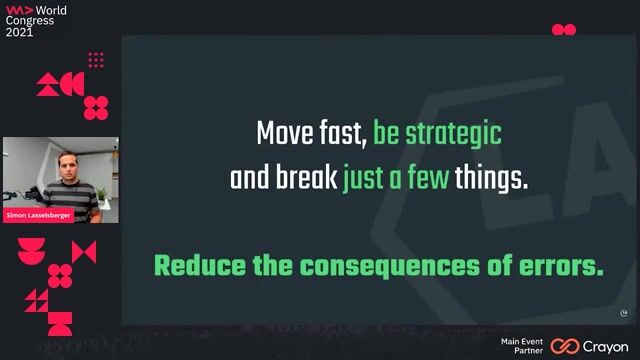
Move fast with Software Architecture
03:56 MIN
Making informed architectural trade-offs with standard protocols
Cloud Vendor Lock-In - Is it just a new version of the Database Abstraction Layers?
Why You Shouldn’t Build a Microservice ArchitectureWelcome to this issue of the WeAreDevelopers Live Talk series. This article recaps an interesting talk by Michael Eisenbart who talks about the pros and cons of microservice architecture.About the speaker:Michael has been working for Bosch as a sof...
Jordan Cutler
A Guide to Public Speaking For Software Engineers“Your technical skills are where they need to be, but you need to improve your communication.” - Your manager. This is one of the hardest pieces of feedback to hear as a software engineer. Why? Because you probably thought as a software engineer you ...
How we Build The Software of TomorrowWelcome to this issue of the WeAreDevelopers Live Talk series. This article recaps an interesting talk by Thomas Dohmke who introduced us to the future of AI – coding.This is how Thomas describes himself:I am the CEO of GitHub and drive the company’s...
From learning to earning
Jobs that call for the skills explored in this talk.


.gif?w=240&auto=compress,format)
.png?w=240&auto=compress,format)