Multilingual NLP pipeline up and running from scratch
Translating text can reduce your NLP model's accuracy by 20%. Learn how to build a single, unified pipeline that handles multiple languages without the loss.
#1about 3 minutes
The challenge of building end-to-end NLP pipelines
There is a lack of comprehensive guides for integrating multilingual NLP models into applications with proper CI/CD practices, especially for non-English languages.
#2about 5 minutes
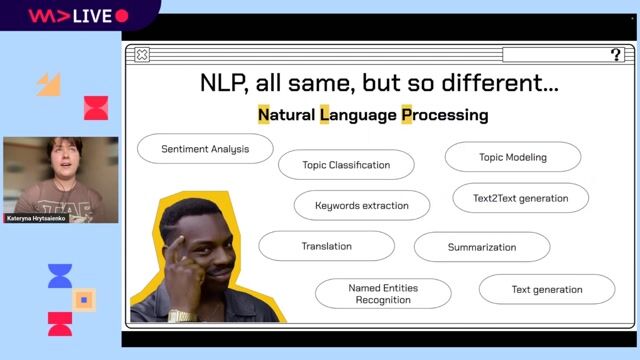
Understanding the core components of an NLP pipeline
A typical NLP pipeline consists of three key stages: pre-processing, feature extraction, and modeling, with pre-processing being critical for handling unstructured data.
#3about 8 minutes
Why simply translating everything to English is not enough
Translating all text to English for NLP analysis can decrease accuracy by up to 20% due to lost semantic nuance and dialectical differences.
#4about 10 minutes
Generalizing languages with stemming and bag-of-words
Handle similar languages by using stemming to find common root words and a bag-of-words model with a similarity index to treat them as a single language.
#5about 5 minutes
Achieving high accuracy with a unified language model
By training classifiers on stemmed and normalized vectors from multiple similar languages, it's possible to achieve high accuracy of around 90% in tasks like topic classification.
#6about 8 minutes
Choosing the right deployment strategy for your model
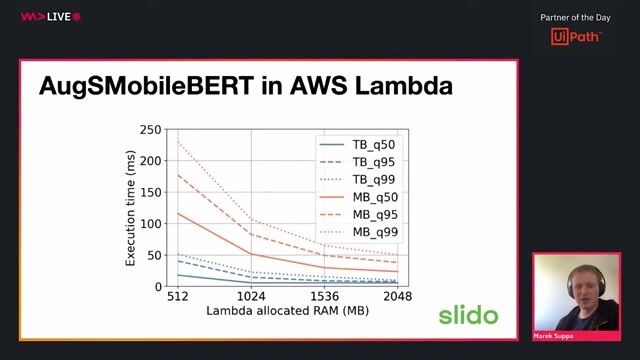
Decide between embedding your model or exposing it as an API, considering options like serverless for simple cases or Kubernetes for scalable, cloud-agnostic deployments.
#7about 7 minutes
Implementing a CI/CD pipeline for your NLP model
Establish an MLOps workflow with continuous training, integration, and delivery by containerizing your model with Docker and automating builds with tools like GitHub Actions.
#8about 6 minutes
Q&A on slang processing, debugging, and transformers
The Q&A covers practical advice on handling slang with dictionaries, debugging with robust logging, and understanding the complexity gap between traditional methods and transformers like BERT.
Related jobs
Jobs that call for the skills explored in this talk.
Matching moments
06:44 MIN
The developer's journey for building AI applications
Supercharge your cloud-native applications with Generative AI
04:09 MIN
Automating the data pipeline with multi-cloud services
Leverage Cloud Computing Benefits with Serverless Multi-Cloud ML
02:49 MIN
Q&A: MLOps tools for building CI/CD pipelines
Data Science in Retail
02:58 MIN
Key takeaways for deploying NLP models serverlessly
Serverless deployment of (large) NLP models
03:30 MIN
Using large language models for voice-driven development
Speak, Code, Deploy: Transforming Developer Experience with Voice Commands
10:46 MIN
Navigating the machine learning project lifecycle
Intelligent Automation using Machine Learning
08:57 MIN
Exploring practical NLP applications at Slido
Serverless deployment of (large) NLP models
02:11 MIN
Global expansion and AI-powered learning platforms
Behind the Scenes: Putting HR and Tech on the Same Stage
MLops – Deploying, Maintaining And Evolving Machine Learning Models in ProductionWelcome to this issue of the WeAreDevelopers Live Talk series. This article recaps an interesting talk by Bas Geerdink who gave advice on MLOps.About the speaker:Bas is a programmer, scientist, and IT manager. At ING, he is responsible for the Fast...
Luis Minvielle
The Top ChatGPT Plugins for Developers in 2023As a software developer, you know that staying ahead of the curve and increasing productivity are crucial to prosperity in a constantly evolving tech industry. But with so many tools and platforms available, it can be overwhelming to figure out where...
Luis Minvielle
What Are Large Language Models?Developers and writers can finally agree on one thing: Large Language Models, the subset of AIs that drive ChatGPT and its competitors, are stunning tech creations. Developers enjoying the likes of GitHub Copilot know the feeling: this new kind of te...
From learning to earning
Jobs that call for the skills explored in this talk.


.gif?w=240&auto=compress,format)
.png?w=240&auto=compress,format)


