Optimizing your AI/ML workloads for sustainability
Up to 90% of your model's carbon footprint comes from inference. Learn key strategies to right-size workloads and slash your environmental impact in the cloud.
#1about 3 minutes
Understanding the carbon footprint of large AI models
The increasing size and complexity of models like GPT-4 result in a significant carbon footprint, with training a single model consuming more energy than a lifetime of car usage.
#2about 3 minutes
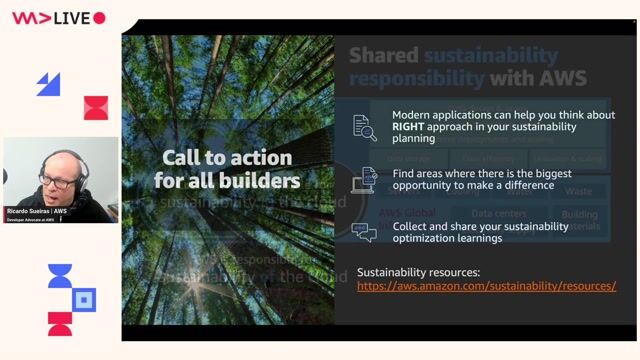
Reducing emissions with the cloud's shared responsibility model
Migrating workloads to a cloud provider like AWS can reduce energy usage by up to 80%, operating under a shared responsibility model where AWS manages the cloud's sustainability.
#3about 5 minutes
Optimizing the ML lifecycle starting with problem framing
Begin the ML lifecycle sustainably by using purpose-built hardware, pre-trained models from marketplaces, and managed AI services to avoid redundant computation.
#4about 6 minutes
Implementing sustainable data processing and storage strategies
Reduce your workload's environmental impact by using tiered storage with lifecycle policies, efficient compression algorithms, and optimized file formats like Parquet.
#5about 2 minutes
Selecting purpose-built hardware for ML workloads
Improve energy efficiency by selecting specialized silicon for different ML phases, such as AWS Trainium for training, Inferentia for inference, and Graviton processors for general workloads.
#6about 3 minutes
Adopting sustainable practices for model development
During model development, define acceptable performance criteria to prevent over-training, choose energy-efficient algorithms, and use pre-trained models to reduce computational waste.
#7about 5 minutes
Optimizing the high-cost model deployment and inference phase
Since deployment accounts for 90% of ML costs, focus on right-sizing inference environments by smoothing traffic peaks with queues and negotiating flexible service level agreements.
#8about 4 minutes
Applying the AWS Well-Architected Framework for sustainability
Use the sustainability pillar of the AWS Well-Architected Framework to get recommendations, such as choosing regions with higher renewable energy usage to lower your carbon footprint.
#9about 2 minutes
Measuring and tracking your workload's carbon footprint
Actively monitor your environmental impact using tools like the AWS Customer Carbon Footprint tool and normalize metrics to track efficiency gains as your workload scales.
#10about 4 minutes
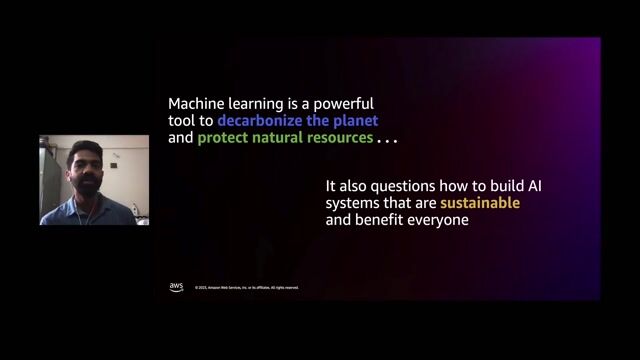
Applying AI and ML to solve global sustainability challenges
Leverage AI/ML for positive environmental impact by using open datasets like the Amazon Sustainability Data Initiative to address challenges in conservation, climate risk, and the circular economy.
#11about 6 minutes
Real-world case studies of ML in environmental conservation
Explore how organizations use ML on satellite imagery to monitor oceans for oil spills and deploy ML at the edge with rugged devices to protect forests and endangered species.
#12about 1 minute
A call to action for building sustainable technology
Take action by starting sustainability conversations, exploring open data initiatives like ASDI, and applying the AWS Well-Architected Framework to your own projects.
Related jobs
Jobs that call for the skills explored in this talk.
Matching moments
01:26 MIN
Using the AWS shared responsibility and well-architected models
An Architect’s guide to reducing the carbon footprint of your applications
02:51 MIN
How AI workloads accelerate energy consumption
Minimising the Carbon Footprint of Workloads
01:33 MIN
Considering the impact and energy cost of AI
Official Opening of WeAreDevelopers World Congress
02:06 MIN
Managing AI's energy consumption with sustainable infrastructure
How to build a sovereign European AI compute infrastructure
02:51 MIN
An overview of the three-layer AWS AI/ML stack
Machine Learning for Software Developers (and Knitters)
03:02 MIN
The future of AI in DevOps and MLOps
Navigating the AI Wave in DevOps
03:38 MIN
The hidden environmental cost of AI-powered development
Are frameworks like React redundant in an AI world?
06:53 MIN
Q&A on model quality, scale, and player privacy
Building the platform for providing ML predictions based on real-time player activity
MLops – Deploying, Maintaining And Evolving Machine Learning Models in ProductionWelcome to this issue of the WeAreDevelopers Live Talk series. This article recaps an interesting talk by Bas Geerdink who gave advice on MLOps.About the speaker:Bas is a programmer, scientist, and IT manager. At ING, he is responsible for the Fast...
Daniel Cranney
Panel Discussion: Responsible AI in Practice - Real-World Examples and ChallengesIntroductionIn the ever-evolving landscape of artificial intelligence, the concept of "responsible AI" has emerged as a cornerstone for ethical and practical AI implementation. During the WWC24 Panel discussion, three eminent experts—Mina, Bjorn Brin...
Exploring AI: Opportunities and Risks for DevelopersIn today's rapidly evolving tech landscape, the integration of Artificial Intelligence (AI) in development presents both exciting opportunities and notable risks. This dynamic was the focus of a recent panel discussion featuring industry experts Kent...
From learning to earning
Jobs that call for the skills explored in this talk.






.gif?w=240&auto=compress,format)