Python-Based Data Streaming Pipelines Within Minutes
Build production-ready streaming pipelines in minutes, not months. This talk introduces a Python-native solution that eliminates complex infrastructure.
#1about 2 minutes
The growing role of Python in real-time data processing
Python is becoming a primary language for real-time data science and machine learning, challenging traditional Java-based tools like Kafka.
#2about 3 minutes
Understanding the challenges of adopting real-time data streaming
Companies hesitate to adopt real-time streaming due to high initial infrastructure costs, the mental shift from batch processing, and inefficient resource usage.
#3about 4 minutes
A traditional approach to streaming with Kafka and Debezium
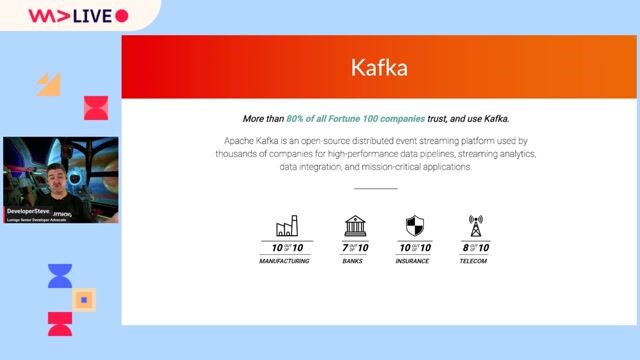
A common but complex streaming architecture involves using Debezium for change data capture and Kafka as a message broker, which presents DevOps challenges.
#4about 7 minutes
Exploring the operational complexity of Kafka and Flink
Combining Kafka for messaging and Apache Flink for computation creates significant operational overhead, requiring specialized roles and complex infrastructure management.
#5about 4 minutes
Simplifying streaming with modern Python-native frameworks
Modern Python frameworks unify the message broker and stream processor, abstracting away infrastructure complexity and enabling developers to focus on business logic.
#6about 3 minutes
Practical applications for real-time Python data pipelines
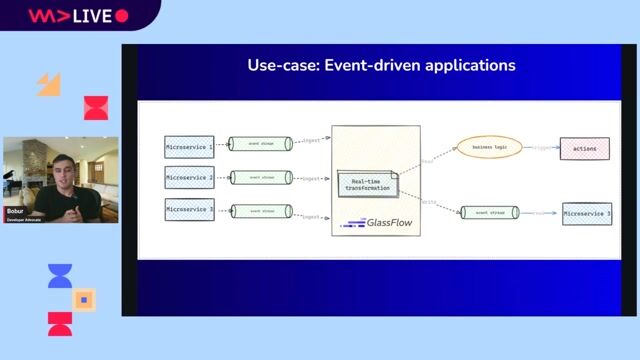
Real-time Python pipelines can power various applications, including clickstream analytics, ad enrichment, vector database updates, and anomaly detection alerts.
#7about 8 minutes
How to build a serverless pipeline with GlassFlow
A step-by-step guide shows how to create a real-time data pipeline using a visual editor, a Python transformation function, and webhooks for integration.
#8about 4 minutes
A live demo of a real-time price prediction pipeline
Watch a live demonstration where new data inserted into a Supabase database is instantly processed by a GlassFlow pipeline to predict a price using AI.
#9about 3 minutes
Key benefits of using Python-native streaming frameworks
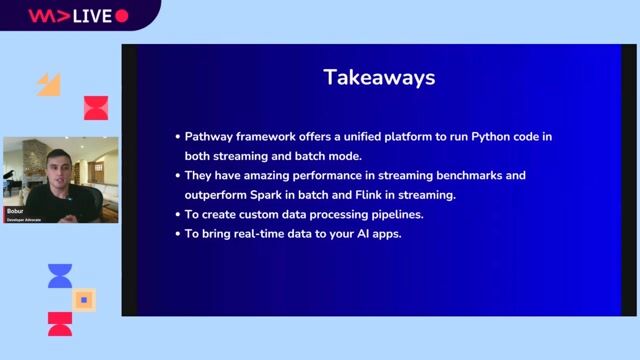
Python-native frameworks provide self-sufficiency for data teams, reduce infrastructure management with serverless execution, and accelerate the development of real-time applications.
Related jobs
Jobs that call for the skills explored in this talk.
Matching moments
04:36 MIN
Why Python is ideal for data streaming frameworks
Convert batch code into streaming with Python
01:52 MIN
Key use cases for Python streaming frameworks
Convert batch code into streaming with Python
01:31 MIN
Key takeaways for modern data processing
Convert batch code into streaming with Python
00:38 MIN
The challenge of managing traditional SQL data pipelines
Enjoying SQL data pipelines with dbt
04:18 MIN
Using streaming data to power real-time agent applications
Unlocking Value from Data: The Key to Smarter Business Decisions-
01:09 MIN
Overview of popular stream processing frameworks
Why and when should we consider Stream Processing frameworks in our solutions
All the videos of Halfstack London 2024!Last month was Halfstack London, a conference about the web, JavaScript and half a dozen other things. We were there to deliver a talk, but also to record all the sessions and we're happy to share them with you. It took a bit as we had to wait for th...
Dev Digest 134 - Where pixels sing?News and ArticlesWeAreDevelopers LIVE Data and Security Day is on Wednesday, 25/09/2024. Learn about OPC UA Updates, Best Practices for Using GitHub Secrets, Passwordless Web 1.5, Emerging AI Security Risks, Data Privacy in LLMs and get a chance to t...
Benedikt Bischof
How we Build The Software of TomorrowWelcome to this issue of the WeAreDevelopers Live Talk series. This article recaps an interesting talk by Thomas Dohmke who introduced us to the future of AI – coding.This is how Thomas describes himself:I am the CEO of GitHub and drive the company’s...
From learning to earning
Jobs that call for the skills explored in this talk.