Microservices architecture as a key element in building trading systems for global finance markets
How do you enforce critical new rules on a live trading system without halting hundreds of thousands of daily inquiries? This talk reveals a practical, phased approach.
#1about 2 minutes
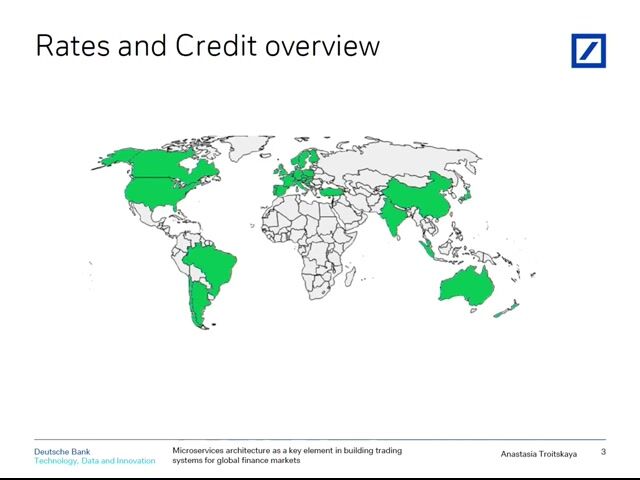
Introduction to building trading systems for global finance
An overview of the complexity of IT systems in investment banking and the key challenges in building a global trading platform.
#2about 3 minutes
Understanding the complexity of financial assets and products
Financial products like bonds, interest rate swaps, and credit default swaps have complex parameters that IT systems must handle correctly.
#3about 3 minutes
The ecosystem of market participants and trading venues
Trading involves external clients and bank dealers interacting across numerous electronic trading venues, each with unique interfaces and protocols.
#4about 2 minutes
Core architectural components and key system challenges
The architecture uses market connectors for venue-specific logic and an order management system for common tasks like validation and routing.
#5about 1 minute
The challenge of onboarding new trading venues efficiently
Onboarding a new venue involves many steps, and a non-scalable approach leads to hundreds of tech stacks and slow time-to-market.
#6about 1 minute
Ensuring trade settlement with preventive validation controls
The settlement process, where assets are transferred, can fail if trade data is incomplete, necessitating preventive controls to validate inquiries upfront.
#7about 3 minutes
A microservices approach to separate generic and specific logic
A scalable architecture separates venue-specific logic into market connectors while centralizing generic business logic like routing in a configurable framework.
#8about 3 minutes
Safely implementing new validation rules using a soft mode
New validation rules are rolled out in a non-blocking "soft mode" with monitoring to avoid disrupting high-volume workflows, supported by business analysts.
#9about 1 minute
Summary of architecture for scalable trading platforms
A recap of the platform structure, key challenges like venue onboarding and validation, and the architectural solutions that address them.
Related jobs
Jobs that call for the skills explored in this talk.
Matching moments
04:03 MIN
The platform challenges of multi-cluster financial services
Monoskope: Developer Self-Service Across Clusters
02:53 MIN
Overview of a modern microservice architecture
Rapid Microservice Development with Project Templates
02:52 MIN
Improving operational efficiency for payments and trades
How to Build for Decentralized Systems
02:04 MIN
The challenge of monitoring at a global scale
Monitoring as Code - Managing your dashboards at scale
02:46 MIN
Understanding critical architectural trade-offs and anti-patterns
Azure-Well Architected Framework - designing mission critical workloads in practice
03:56 MIN
Making informed architectural trade-offs with standard protocols
Cloud Vendor Lock-In - Is it just a new version of the Database Abstraction Layers?
02:37 MIN
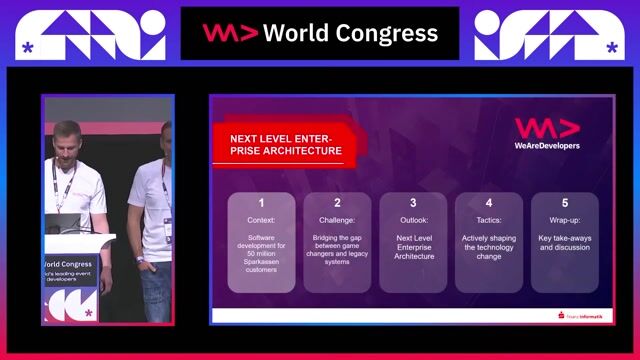
Understanding the scale of a large financial services platform
Next Level Enterprise Architecture: Modular, Flexible, Scalable, Multichannel and AI-Ready?
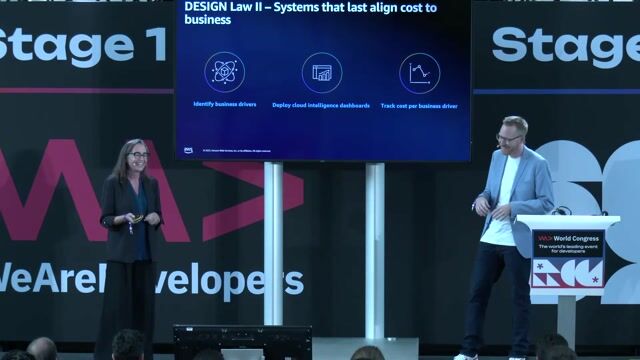
02:53 MIN
Making architecture trade-offs to reduce dashboard costs
Mastering AWS Cost Optimization: Real-world technical and operational cost-saving best practices
Why You Shouldn’t Build a Microservice ArchitectureWelcome to this issue of the WeAreDevelopers Live Talk series. This article recaps an interesting talk by Michael Eisenbart who talks about the pros and cons of microservice architecture.About the speaker:Michael has been working for Bosch as a sof...
Chris Heilmann
All the videos of Halfstack London 2024!Last month was Halfstack London, a conference about the web, JavaScript and half a dozen other things. We were there to deliver a talk, but also to record all the sessions and we're happy to share them with you. It took a bit as we had to wait for th...
Micro Components - a different approach to a simpler component-based webThere has been a lot of heated discussion lately in the web community about component based development. One side argued that Web Components are a standard we should follow whereas others complained that they still lag behind in what frameworks offer...
From learning to earning
Jobs that call for the skills explored in this talk.




.gif?w=240&auto=compress,format)