A database pod fails. Instead of panic, the cluster automatically provisions a new node and rebalances data to restore a healthy state—all without human intervention.
#1about 3 minutes
The evolution of running databases in containers
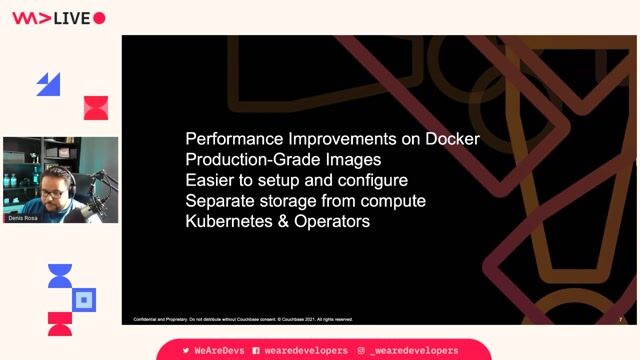
The community's perspective shifted from advising against running databases in containers to embracing it due to improvements in Docker and the rise of Kubernetes.
#2about 1 minute
Challenges of a naive database deployment on Kubernetes
A simple deployment of a database like MySQL on Kubernetes creates configuration management problems and requires maintaining multiple container images.
#3about 5 minutes
Using custom resource definitions to manage configuration
Custom Resource Definitions (CRDs) extend the Kubernetes API, allowing you to store application-specific configuration directly within the cluster.
#4about 4 minutes
Understanding stateful application failures in Kubernetes
Standard Kubernetes deployments fail to manage stateful applications like databases because they don't handle node failures, pod affinity, or state recovery automatically.
#5about 5 minutes
The Kubernetes operator pattern for database automation
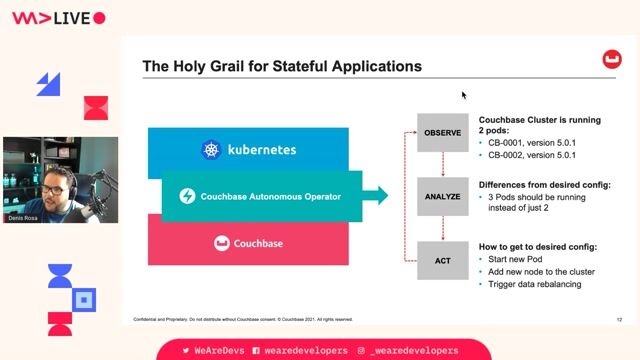
The operator pattern uses custom controllers to listen for events and encode operational knowledge, automating complex tasks like database recovery and upgrades.
#6about 10 minutes
Live demo of the Couchbase operator in action
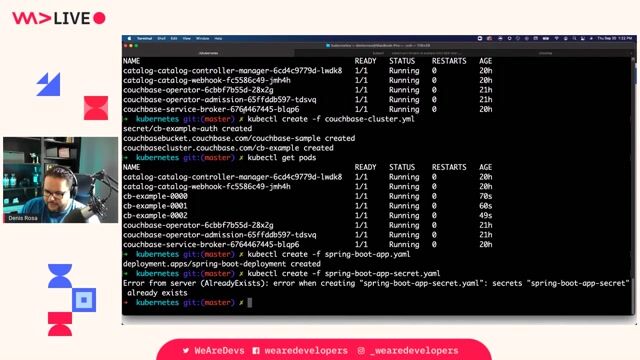
The Couchbase operator demonstrates self-healing by automatically replacing a deleted pod, rejoining it to the cluster, and rebalancing data without manual intervention.
#7about 7 minutes
Scaling and upgrading a database with an operator
Operators simplify complex operations like scaling out nodes, performing rolling upgrades, and tuning resource allocation by just modifying a declarative configuration file.
#8about 3 minutes
Comparing managed DBaaS with databases on Kubernetes
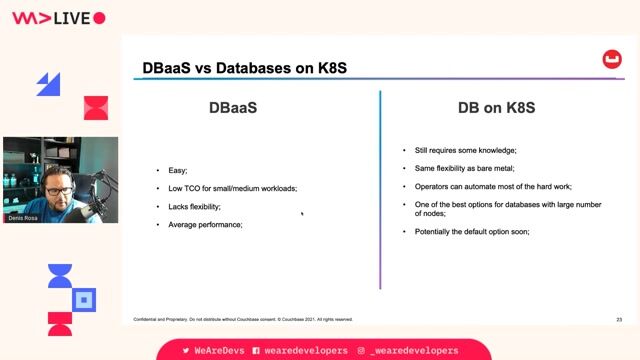
While managed DBaaS is simpler for small workloads, running databases on Kubernetes with operators provides greater flexibility, control, and cost-effectiveness at scale.
#9about 4 minutes
Storage and performance considerations on Kubernetes
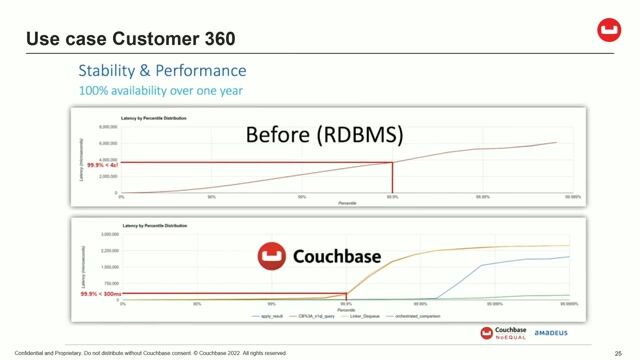
Using local persistent storage is recommended for performance, and benchmarks show only a minimal 3-4% overhead when running databases in containers versus bare metal.
#10about 1 minute
Key takeaways for running databases on Kubernetes
When running databases on Kubernetes, choose a mature operator, prefer local persistent storage, and account for a small performance overhead compared to bare metal.
Related jobs
Jobs that call for the skills explored in this talk.
Matching moments
03:02 MIN
A DBA's journey to running SQL Server on Kubernetes
Adjusting Pod Eviction Timings in Kubernetes
04:52 MIN
Managing any Oracle database with a Kubernetes operator
Kubernetes and Microservices with Multi-Model Databases
03:38 MIN
Comparing self-managed Kubernetes databases to DBaaS
Databases on Kubernetes
08:49 MIN
Deploying a database cluster using a YAML file
Databases on Kubernetes
04:41 MIN
Why running databases in containers is now a reality
Databases on Kubernetes
07:53 MIN
Automating database recovery and scaling with an operator
Databases on Kubernetes
04:45 MIN
Q&A on hybrid cloud strategy and data management
Embracing the Hybrid Cloud: Unlocking Success with Open Source Technologies
02:05 MIN
Implementing a global hybrid-cloud database architecture
Learning Kubernetes made easy with KubeCampusLearning to use Kubernetes? KubeCampus by Kasten offers free educational content for all skill levels to get you started!Kubernetes is an open-source system for deploying, scaling and managing containerized applications. It allows you to deploy your ...
Chris Heilmann
WeAreDevelopers LIVE days are changing - get ready to take partStarting with this week's Web Dev Day edition of WeAreDevelopers LIVE Days, we changed the the way we run these online conferences. The main differences are:Shorter talks (half an hour tops)More interaction in Q&AA tips and tricks "Did you know" sect...
Daniel Cranney
Coffee with Developers is Now Available as an Audio PodcastFor the past few years, we’ve had the privilege of meeting fascinating developers and tech professionals from around the world through our Coffee with Developers episodes. While all of the episodes are available in their original video format on our ...