What if you could treat code as data? Learn how to build custom linters, IDE extensions, or even your own programming language from scratch.
#1about 4 minutes
The value of understanding language internals
Learning how programming languages work is valuable for all developers, enabling the creation of custom linting rules, IDE extensions, and domain-specific languages (DSLs).
#2about 3 minutes
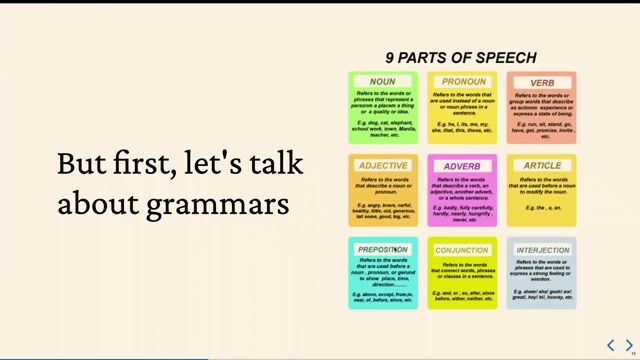
Understanding language grammars and structure
Programming languages are defined by grammars, which are sets of rules that distinguish between regular grammars (predictable, sequential) and context-free grammars (recursive, complex).
#3about 3 minutes
Distinguishing between interpreters and compilers
Languages are not inherently interpreted or compiled; their implementations are, with some systems like V8 using both a compiler and an interpreter.
#4about 3 minutes
Exploring the code processing pipeline
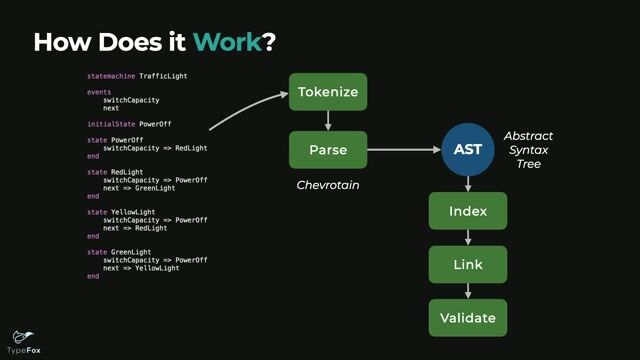
Code is processed through a pipeline that includes scanning (lexing), parsing into an abstract syntax tree (AST), analysis, and finally evaluation by an interpreter or compiler.
#5about 6 minutes
Building a lexer and parser with typescript-parsec
A live demonstration shows how to use typescript-parsec to build a lexer that creates a stream of tokens and a parser that organizes them into an abstract syntax tree (AST).
#6about 3 minutes
Implementing a simple tree-walk interpreter
The interpreter is built as a recursive function that walks the abstract syntax tree (AST), evaluating each node to produce a final result while managing variable scope.
#7about 8 minutes
Extending the language with a custom print syntax
A new print feature using a question mark suffix is added by updating the lexer to recognize the token, the parser to create a new AST node, and the interpreter to handle the new logic.
#8about 1 minute
Conclusion and resources for language development
The talk concludes by sharing the open-source project and providing resources for anyone interested in exploring programming language creation further.
Related jobs
Jobs that call for the skills explored in this talk.
Matching moments
03:28 MIN
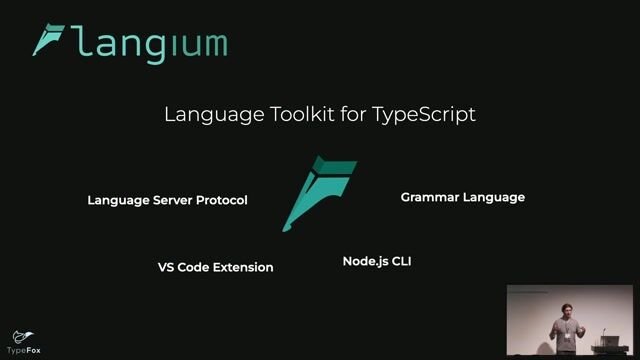
Introducing the Langium framework for language engineering
Langium: Design your own language in Node.js and VS Code
00:57 MIN
Approaching the live pair programming challenge
Coffee with Developers - Jonathan Tang
02:27 MIN
Final thoughts on learning from alien programming languages
Java with a Clojure mindset
03:34 MIN
How Langium processes code into an abstract syntax tree
Langium: Design Your Own Language in Node.js and VS Code
02:45 MIN
An overview of the Langium framework
Langium: Design Your Own Language in Node.js and VS Code
13:13 MIN
Manipulating code reliably with Abstract Syntax Trees
Let's build a VS Code extension for automated refactorings
16:54 MIN
Q&A on type systems and legacy code
Typed Security: Preventing Vulnerabilities By Design
How we Build The Software of TomorrowWelcome to this issue of the WeAreDevelopers Live Talk series. This article recaps an interesting talk by Thomas Dohmke who introduced us to the future of AI – coding.This is how Thomas describes himself:I am the CEO of GitHub and drive the company’s...
Anto Pranjić
11 Tips to Make The Most Out of Your First World Congress The world’s most awesome event for developers is taking place in less than a month! It’s been far too long since the last time we met in person, but that’s only going to make this year’s WeAreDevelopers World Congress a truly special experience. Conf...
From learning to earning
Jobs that call for the skills explored in this talk.