Using WebAssembly to run, extend, and secure your application
Docker's co-founder said if WASM existed in 2008, Docker wouldn't be necessary. Learn why this secure runtime is revolutionizing server-side applications.
#1about 3 minutes
Understanding WebAssembly and its initial industry adoption
WebAssembly is a portable binary format first used to run existing C codebases like AutoCAD in the browser and to build cross-platform SDKs for services like Disney+.
#2about 3 minutes
Exploring the foundational security features of WebAssembly
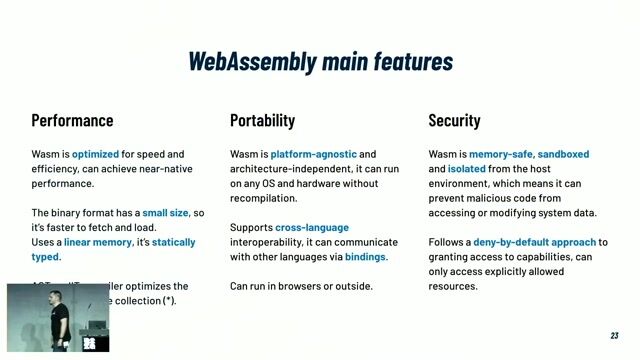
WebAssembly ensures security by default through isolated linear memory for each module and control flow integrity that prevents unintended code execution paths.
#3about 1 minute
How .NET applications execute on WebAssembly
.NET applications run on WebAssembly by compiling the .NET runtime (CLR) itself into a WASM module, which then interprets the standard .NET DLLs.
#4about 3 minutes
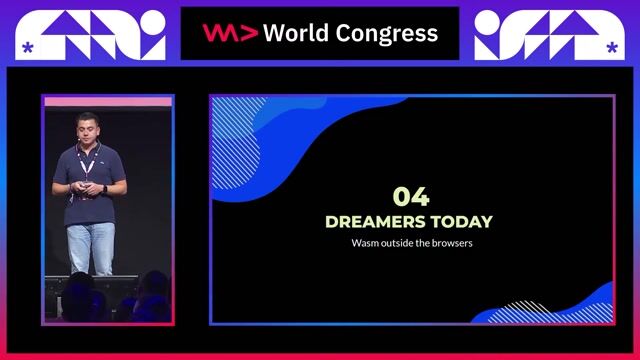
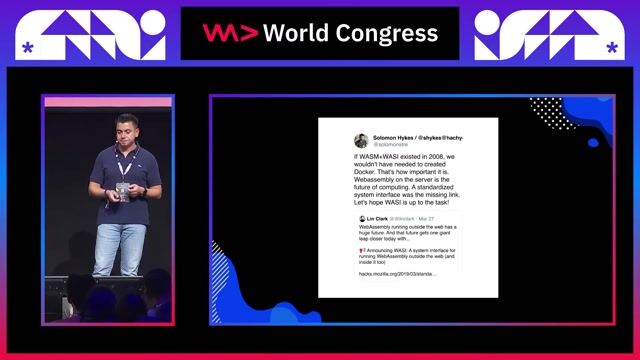
Taking WebAssembly beyond the browser with WASI
The WebAssembly System Interface (WASI) provides a standard API for running WASM modules outside the browser, enabling server-side applications with a capability-based security model.
#5about 4 minutes
Securing file system access in a .NET WASI application
A practical demonstration shows how a .NET application running on Wasmtime is denied file system access by default and requires explicit permissions to be granted.
#6about 3 minutes
Using a Rust WASM module to extend a .NET application
This example demonstrates how to extend a .NET host application with a WebAssembly module written in Rust, while still enforcing strict, capability-based security policies.
#7about 3 minutes
Securing dependencies with the nano-process model
The nano-process concept provides a fine-grained sandbox for each module, preventing malicious or vulnerable dependencies from gaining unauthorized access to system resources.
#8about 3 minutes
Ensuring the security and correctness of the WASM runtime
The security of the entire ecosystem relies on the runtime, and projects like Wasmtime use Rust, formal verification, and fuzzing to ensure its correctness and robustness.
Related jobs
Jobs that call for the skills explored in this talk.
Matching moments
03:05 MIN
Running WebAssembly on the server with WASI
WebAssembly Revolution: Elevating JavaScript's Reach and Performance
02:30 MIN
WebAssembly as the next evolution of cloud computing
WebAssembly Revolution: Elevating JavaScript's Reach and Performance
02:19 MIN
What WebAssembly is and its role on the web
WebAssembly: Disassembled
05:41 MIN
Defining WebAssembly and its original design goals
Fun with PaaS – How to use Cloud Foundry and its uniqueness in creative ways
05:04 MIN
Demonstrating Wasm with Rust and the WASI interface
WebAssembly: The Next Frontier of Cloud Computing
04:49 MIN
Understanding the original design goals of WebAssembly
WWC24 Talk - Scott Hanselman - AI: Superhero or Supervillain?Join Scott Hanselman at WWC24 to explore AI's role as a superhero or supervillain. Scott shares his 32 years of experience in software engineering, discusses AI myths, ethical dilemmas, and tech advancements. Engage with his live demos and insights o...
Chris Heilmann
Micro Components - a different approach to a simpler component-based webThere has been a lot of heated discussion lately in the web community about component based development. One side argued that Web Components are a standard we should follow whereas others complained that they still lag behind in what frameworks offer...
Luis Minvielle
The Best Upcoming IT WebinarsNow that you already know what IT webinars are and how they can help you level up your professional appeal, you might want actually to get into one. Live tech webinars are one of the best ways to stay on top of the latest trends and tools because eit...


.webp?w=240&auto=compress,format)