Design Systems and how to develop consistent and scalable products with them
Your design system isn't just a style guide—it's a living product. Learn the five steps to build, maintain, and evolve one for scalable development.
#1about 5 minutes
Understanding the core components of a design system
A design system is a single source of truth built on a style guide, a component library, and a pattern library.
#2about 2 minutes
Step 1: Convincing stakeholders with data-driven inventories
Create inventories of existing styles and components to highlight inconsistencies and redundancies, then convert these findings into numbers to get stakeholder buy-in.
#3about 2 minutes
Step 2: Researching user needs and auditing existing resources
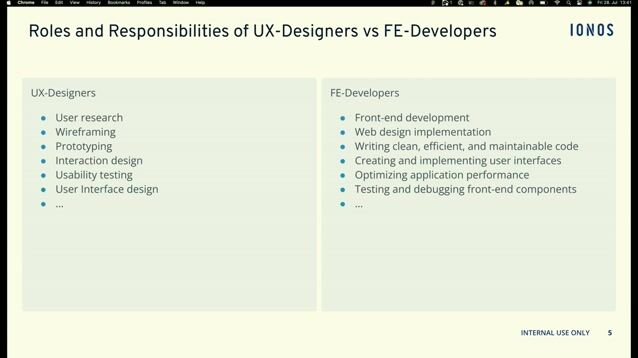
Understand who will use the design system by interviewing them, auditing current processes, and creating a glossary of terms to align teams.
#4about 3 minutes
Step 3: Designing the style guide and component library
Choose your design tools and start by defining essential styles like colors and typography before moving on to creating your first components and patterns.
#5about 1 minute
Step 4: Crafting the system with code and documentation
Select the right technologies and frameworks, set up a CI/CD pipeline, and build out the libraries with tests and technical documentation.
#6about 3 minutes
Step 5: Maintaining and evolving the design system
Establish contribution models, create communication channels, find team ambassadors, and continuously measure success to ensure long-term adoption.
#7about 8 minutes
Documenting components with a live Storybook demo
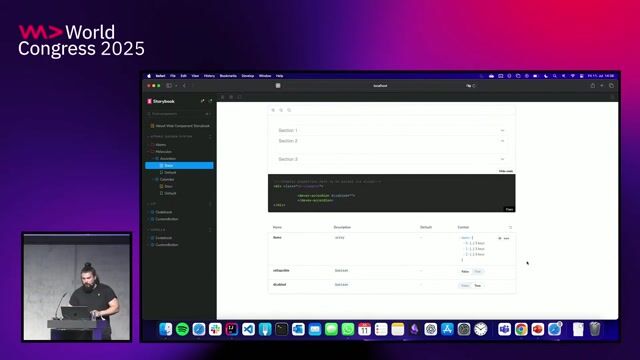
Storybook helps document components by providing self-hosting, add-ons like Figma integration, and interactive stories for different component variants.
#8about 7 minutes
Q&A: Decoupling from tech and handling legacy systems
Discussion on using design tokens to remain technology-agnostic, inventorying existing systems to merge them, and creating stories for complex components.
Related jobs
Jobs that call for the skills explored in this talk.
Matching moments
01:19 MIN
Creating a cohesive user experience with design systems
Microfrontends at Scale
03:31 MIN
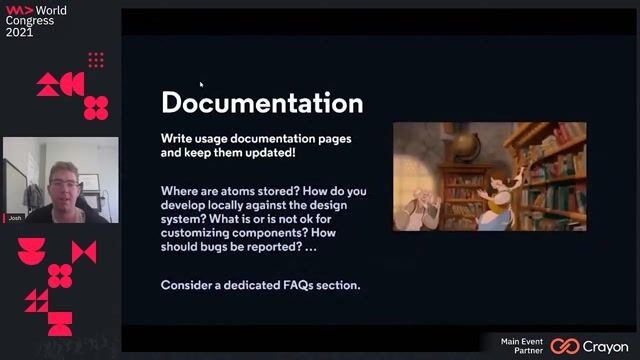
Best practices for documenting a design system
Microfrontends at Scale
04:55 MIN
Creating a shared language with design systems
Bridging the gap between design and development
01:35 MIN
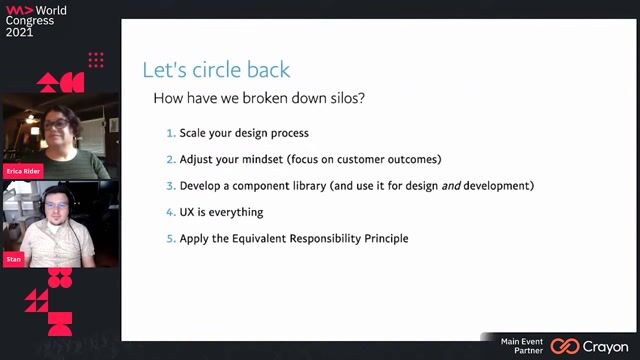
Summary of breaking down design and development silos
Breaking Down Silos Between Design and Development
02:32 MIN
Exploring the IBM Carbon Design System as an example
Building a framework-independent component library
01:40 MIN
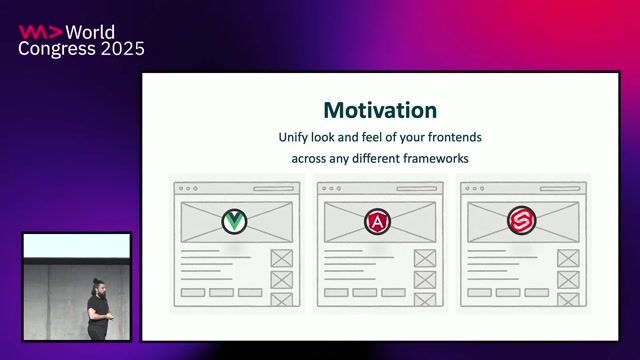
Sharing UI components and ensuring design consistency
Independently together: how micro-applications improve developer experience + app performance
01:08 MIN
Using Figma to design and standardize UI components
A Guide to Public Speaking For Software Engineers“Your technical skills are where they need to be, but you need to improve your communication.” - Your manager. This is one of the hardest pieces of feedback to hear as a software engineer. Why? Because you probably thought as a software engineer you ...
Chris Heilmann
Micro Components - a different approach to a simpler component-based webThere has been a lot of heated discussion lately in the web community about component based development. One side argued that Web Components are a standard we should follow whereas others complained that they still lag behind in what frameworks offer...
Anto Pranjić
11 Tips to Make The Most Out of Your First World Congress The world’s most awesome event for developers is taking place in less than a month! It’s been far too long since the last time we met in person, but that’s only going to make this year’s WeAreDevelopers World Congress a truly special experience. Conf...
Chris Heilmann
All the videos of Halfstack London 2024!Last month was Halfstack London, a conference about the web, JavaScript and half a dozen other things. We were there to deliver a talk, but also to record all the sessions and we're happy to share them with you. It took a bit as we had to wait for th...
From learning to earning
Jobs that call for the skills explored in this talk.







.png?w=240&auto=compress,format)