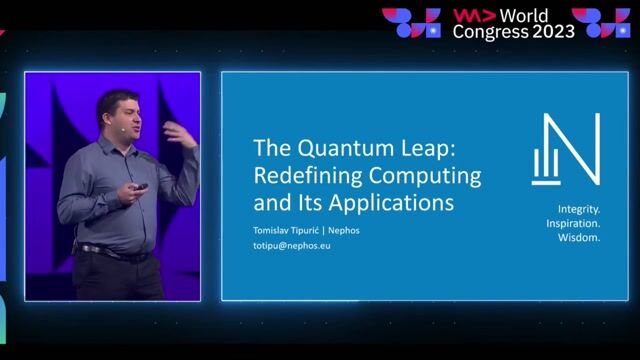
The Quantum Leap: Redefining Computing and Its Applications
A classical computer might take a billion years to break modern encryption. A quantum computer could do it in minutes.
#1about 6 minutes
Why classical computers are reaching their physical limits
Classical computers struggle with complex global problems because Moore's Law is ending as transistors approach the atomic scale, creating a need for a new computing paradigm.
#2about 3 minutes
How quantum computers can break modern encryption
The problem of factoring large prime numbers, which is the foundation of RSA encryption, demonstrates how quantum algorithms can solve exponentially complex problems in linear time.
#3about 2 minutes
Understanding the qubit and quantum superposition
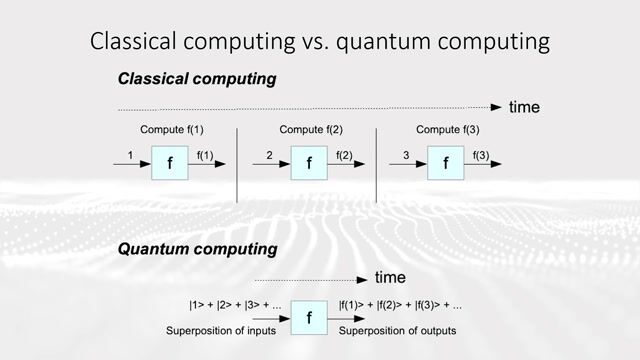
Unlike a classical bit that is either 0 or 1, a qubit can exist in a superposition of both states simultaneously, unlocking immense computational potential.
#4about 4 minutes
Manipulating qubits using quantum gates and logic
Quantum gates, analogous to classical logic gates, are used to manipulate the probabilistic states of qubits, with simulations requiring exponential amounts of classical memory.
#5about 3 minutes
Harnessing interference and quantum entanglement
Quantum computing leverages interference to amplify correct answers and cancel wrong ones, while entanglement links qubit states instantly regardless of distance.
#6about 2 minutes
The probabilistic nature of quantum measurement
Due to the no-cloning principle, measuring a qubit collapses its superposition and provides the most probable answer, not a deterministic one.
#7about 3 minutes
The industry race to build stable quantum hardware
Companies like IBM, Google, and Microsoft are developing different hardware approaches, such as superconductors and topological qubits, while battling high error rates.
#8about 5 minutes
Exploring future applications of quantum computing
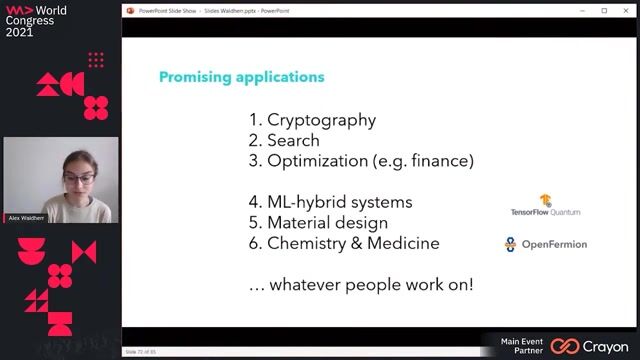
Quantum computers promise to revolutionize fields like material science for better batteries, drug discovery, carbon capture, and training next-generation artificial intelligence models.
Related jobs
Jobs that call for the skills explored in this talk.
Matching moments
02:10 MIN
Why quantum computing is the successor to Moore's Law
Quantum DevOps - Quantum Application Development
03:41 MIN
Applying quantum computing to real-world problems
The Quantum Computing Future
03:29 MIN
Exploring key use cases for quantum advantage
The Quantum Computing Future
01:51 MIN
Understanding the exponential leap of quantum computation
Quantum Tech: Preparing for the Next Leap
03:05 MIN
The future of quantum hardware and learning resources
Schroedinger's cat: Thinking in- and outside the box of quantum mechanics
04:48 MIN
Understanding the fundamentals of quantum computing
Quantum computing for developers: Solving optimization problems with Qiskit
06:22 MIN
Achieving quantum advantage today with hybrid computing models
Quantum Tech: Preparing for the Next Leap
05:39 MIN
The origin and exponential power of quantum computing
The Fastest-Growing Tech Sectors to Look Out for in 2025Whether you are a tech enthusiast, an aspiring developer or a triple-crown investor, keeping up with the latest tech trends can be both highly beneficial and remarkably tiring. As 2024 kicks off, some industries that were backwater contenders some ye...
Benedikt Bischof
How we Build The Software of TomorrowWelcome to this issue of the WeAreDevelopers Live Talk series. This article recaps an interesting talk by Thomas Dohmke who introduced us to the future of AI – coding.This is how Thomas describes himself:I am the CEO of GitHub and drive the company’s...
Daniel Cranney
What does the history of data storage tell us about the future?In the rapidly advancing world of computing, data storage stands as a cornerstone that has evolved profoundly over the decades, adapting to meet growing demands for durability, scalability, and accessibility. From early physical storage methods to to...
.webp?w=240&auto=compress,format)