An AI classified a husky as a wolf because of the snow in the background. This is why explainability is crucial for building reliable models.
#1about 2 minutes
The growing importance of explainable AI in modern systems
Machine learning has become widespread, creating a critical need to understand how models make decisions beyond simple accuracy metrics.
#2about 4 minutes
Why regulated industries like medtech and fintech require explainability
In fields like medicine and finance, regulatory compliance and user trust make it mandatory to explain how AI models arrive at their conclusions.
#3about 3 minutes
Identifying the key stakeholders who need model explanations
Explainability is crucial for various roles, including domain experts like doctors, regulatory agencies, business leaders, data scientists, and end-users.
#4about 4 minutes
Fundamental approaches for explaining AI model behavior
Models can be explained through various methods such as mathematical formulas, visual charts, local examples, simplification, and analyzing feature relevance.
#5about 5 minutes
Learning from classic machine learning model failures
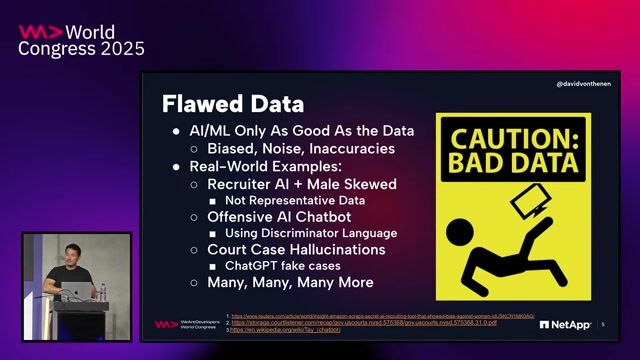
Examining famous failures, like the husky vs. wolf classification and the Tay chatbot, reveals how models can learn incorrect patterns from biased data.
#6about 5 minutes
Differentiating between white-box and black-box models
White-box models like decision trees are inherently transparent, whereas black-box models like neural networks require special techniques to interpret their internal workings.
#7about 7 minutes
Improving model performance with data-centric feature engineering
A data-centric approach, demonstrated with the Titanic dataset, shows how creating new features from existing data can significantly boost model accuracy.
Models such as logistic regression, k-means, decision trees, and SVMs are considered explainable by design due to their transparent decision-making processes.
#9about 5 minutes
Using methods like LIME and SHAP to explain black-box models
Techniques like Partial Dependence Plots (PDP), LIME, and SHAP are used to understand the influence of features on the predictions of complex black-box models.
#10about 3 minutes
Visualizing deep learning decisions in images with Grad-CAM
Grad-CAM (Gradient-weighted Class Activation Mapping) creates heatmaps to highlight which parts of an image were most influential for a deep neural network's classification.
#11about 3 minutes
Understanding security risks from adversarial attacks on models
Adversarial attacks demonstrate how small, often imperceptible, changes to input data can cause machine learning models to make completely wrong predictions.
Related jobs
Jobs that call for the skills explored in this talk.
Matching moments
02:19 MIN
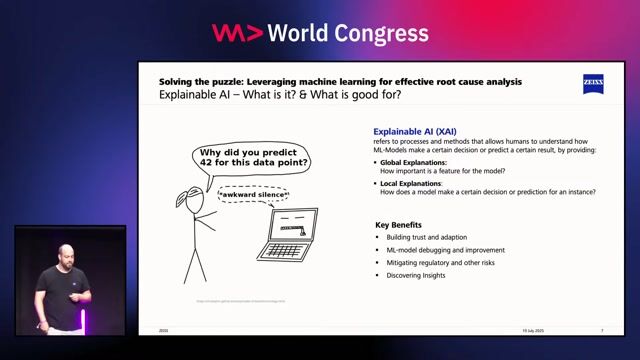
Using explainable AI to understand black box models
Solving the puzzle: Leveraging machine learning for effective root cause analysis
01:27 MIN
The importance of explainable AI and data quality
Confuse, Obfuscate, Disrupt: Using Adversarial Techniques for Better AI and True Anonymity
02:38 MIN
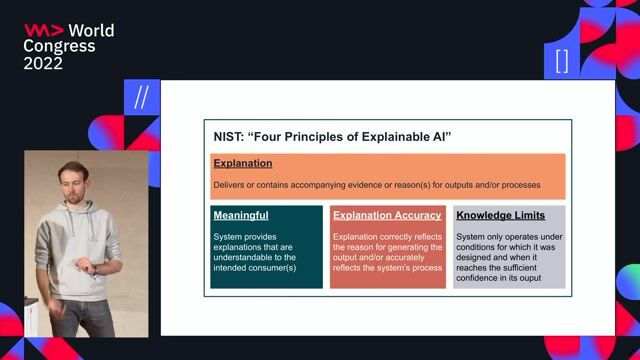
The four core principles of explainable AI
Model Governance and Explainable AI as tools for legal compliance and risk management
05:04 MIN
Q&A on model reliability and explainable AI
Getting Started with Machine Learning
04:21 MIN
Visualizing AI patterns to make them accessible
The shadows of reasoning – new design paradigms for a gen AI world
01:24 MIN
Auditing AI systems using MLOps and explainability
Model Governance and Explainable AI as tools for legal compliance and risk management
04:53 MIN
Techniques for model interpretability and transparency
Augmented Intelligence for transport planning: Human in the Loop Modelling
03:50 MIN
Differentiating between model interpretability and explainability
Model Governance and Explainable AI as tools for legal compliance and risk management
Exploring AI: Opportunities and Risks for DevelopersIn today's rapidly evolving tech landscape, the integration of Artificial Intelligence (AI) in development presents both exciting opportunities and notable risks. This dynamic was the focus of a recent panel discussion featuring industry experts Kent...
Daniel Cranney
Panel Discussion: Responsible AI in Practice - Real-World Examples and ChallengesIntroductionIn the ever-evolving landscape of artificial intelligence, the concept of "responsible AI" has emerged as a cornerstone for ethical and practical AI implementation. During the WWC24 Panel discussion, three eminent experts—Mina, Bjorn Brin...
Stephan Gillich - Bringing AI EverywhereIn the ever-evolving world of technology, AI continues to be the frontier for innovation and transformation. Stephan Gillich, from the AI Center of Excellence at Intel, dove into the subject in a recent session titled "Bringing AI Everywhere," sheddi...
From learning to earning
Jobs that call for the skills explored in this talk.