What if you could write 40% less code and eliminate null pointer exceptions forever? Kotlin offers a pragmatic path to modernizing your Java applications.
#1about 3 minutes
An introduction to Kotlin and its Java interoperability
Kotlin was designed as a "better Java" that maintains full interoperability with the existing Java ecosystem, tools, and frameworks.
#2about 4 minutes
Modern object orientation with Kotlin data classes
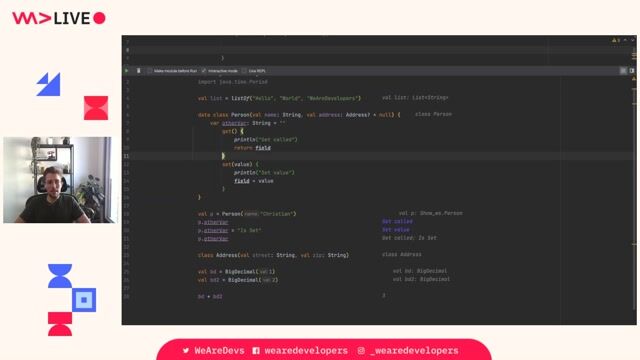
Kotlin simplifies object-oriented code with features like primary constructors, default arguments, and data classes that replace Java boilerplate.
#3about 1 minute
Leveraging functional programming with first-class functions
Functions are treated as first-class citizens in Kotlin, which simplifies the syntax for higher-order functions compared to Java's functional interfaces.
#4about 3 minutes
Achieving robust null safety at the type level
Kotlin's type system distinguishes between nullable and non-nullable types to prevent null pointer exceptions at compile time.
#5about 2 minutes
Extending existing types using extension functions
Extension functions allow you to add new functionality to existing classes without inheriting from them, which is useful for creating utility methods and DSLs.
#6about 3 minutes
Working with immutable and expressive collections
Kotlin's collections API prefers immutability by default and provides a rich set of straightforward transformation functions without Java's primitive type complexities.
#7about 3 minutes
Simplifying concurrency with structured coroutines
Coroutines enable writing asynchronous, non-blocking code in a sequential style, avoiding the complexity of reactive frameworks like Project Reactor.
#8about 2 minutes
Making the business case for adopting Kotlin
Adopting Kotlin offers a strong return on investment through increased developer productivity, fewer bugs, and the ability to reuse existing framework knowledge.
#9about 5 minutes
A practical guide to gradual Kotlin adoption
A live demonstration shows how to start using Kotlin in a Java project by converting tests and JPA entities with IntelliJ's automated tools.
#10about 2 minutes
Strategies for successful company-wide adoption
Successfully rolling out Kotlin across an organization involves creating a roadmap, building an internal community, and providing training to foster idiomatic coding practices.
Related jobs
Jobs that call for the skills explored in this talk.
Matching moments
02:58 MIN
Introduction to Kotlin and its Java interoperability
Route from Java to Kotlin
05:51 MIN
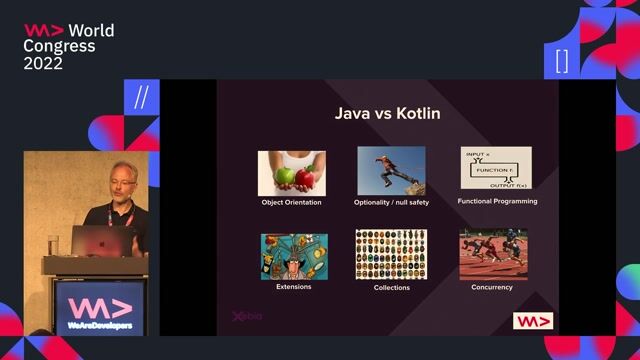
A high-level comparison of Kotlin and Java
Why Kotlin is the better Java and how you can start using it
05:04 MIN
Achieving interoperability between Java and Kotlin code
Why Kotlin is the better Java and how you can start using it
07:37 MIN
Q&A: Comparing Kotlin's ecosystem and future outlook
Why Kotlin is the better Java and how you can start using it
10:56 MIN
Audience Q&A on Kotlin features and learning resources
Route from Java to Kotlin
01:43 MIN
The compelling case for migrating to modern Java
Beam Me Up, Java! Unraveling the Warp-Speed Evolution: A Journey through Java LTS Versions 11 to 21
03:03 MIN
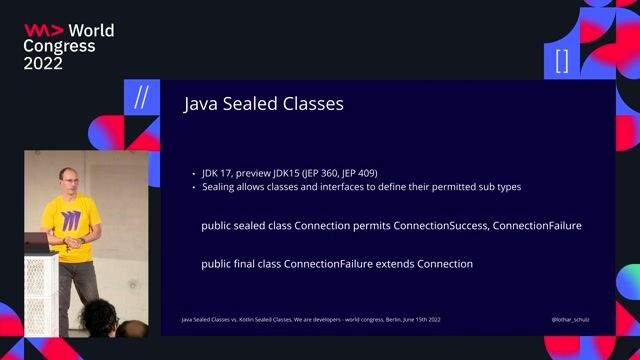
Conclusion on Java vs Kotlin sealed class parity
Java Sealed Classes vs. Kotlin Sealed Classes #Slideless
01:48 MIN
Key takeaways for starting with Kotlin Multiplatform
Kotlin Multiplatform - True power of native code reuse
Using Java 17 latest features in real world projectsWelcome to this issue of the WeAreDevelopers Live Talk series. This article recaps an interesting talk by Ron Veen who introduced the audience to some of the most interesting features that got added to the Java language.About the speaker:Ron is a hig...
Anto Pranjić
That was WeAreDevelopers World Congress 2022Thank you, danke, hvala, merci, gracias, Дякую – we don’t know yet exactly how many languages were spoken here at the City Cube Berlin over the last two days, but thank you 10 000 times to everybody who joined us here for WeAreDevelopers World Congre...
Benedikt Bischof
Java BasicsIn 1991,James Gosling invented a high-level, general-purpose, object-oriented andsecure programming language and called it OAK (after a tree in front of hiswindow). And four years later, in 1995, it was renamed after one of the GreaterSunda Islands: ...
From learning to earning
Jobs that call for the skills explored in this talk.





.gif?w=240&auto=compress,format)

.gif?w=240&auto=compress,format)