An unoptimized 10MB website requires 28 trees to compensate for its carbon output. Discover how to shrink your bundle size and build a more sustainable web.
#1about 1 minute
The growing impact of websites on the climate
The increasing size and usage of websites have a direct and growing impact on global energy consumption and the climate.
#2about 3 minutes
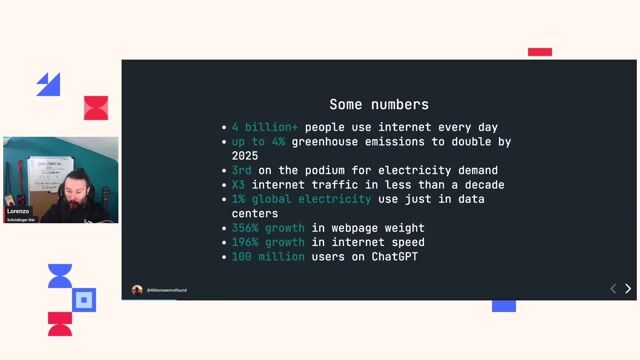
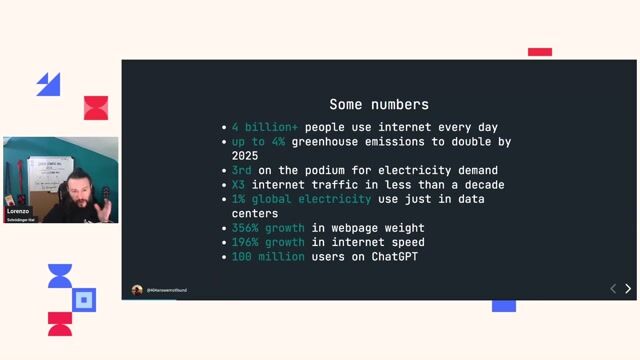
Website size and data center energy consumption are exploding
The average website is four times larger than a decade ago, and data centers now account for a significant percentage of national energy usage.
#3about 6 minutes
How modern internet usage habits drive data consumption
Increased daily screen time, the shift to mobile-first browsing, and the rise of e-commerce are key drivers of higher internet data consumption.
#4about 4 minutes
Why large JavaScript bundles are bad for users and the planet
Large JavaScript bundles not only create slow user experiences by consuming bandwidth but also strain device CPUs, increasing energy use on both ends.
#5about 4 minutes
Comparing the simple web of the past to today's complex sites
A look back at websites from a decade ago reveals a shift from simple text and low-res images to today's media-rich, interactive, and heavier applications.
#6about 6 minutes
The shift from jQuery to modern JavaScript frameworks
Web development has evolved from using jQuery for simple interactions to building entire applications with powerful but heavier frameworks like React, Angular, and Vue.
#7about 5 minutes
Measuring a website's carbon footprint with online tools
Tools like Website Carbon estimate a site's environmental impact by analyzing data transfer, CPU intensity, and the data center's energy source.
#8about 5 minutes
Case study of a bloated website's high carbon footprint
Analyzing a deliberately heavy website with a 10MB bundle reveals a massive carbon footprint, equivalent to driving an electric car for thousands of kilometers.
#9about 4 minutes
Case study of a minimal website's low carbon footprint
In contrast, a simple static HTML site with a tiny 20KB footprint is shown to be extremely energy-efficient, requiring almost no carbon offset.
#10about 5 minutes
Using static site generators and Jamstack for efficiency
Building websites with static site generators (SSGs) and the Jamstack architecture pre-renders pages, resulting in smaller bundles and faster performance.
#11about 4 minutes
Understanding Jamstack architecture and incremental static generation
The Jamstack decouples the frontend from backend services, and incremental static generation (ISG) optimizes build times for very large sites.
#12about 3 minutes
Compressing assets with Gzip and Brotli for smaller transfers
Implementing server-side compression like Gzip, and especially the more efficient Brotli, significantly reduces the amount of data transferred to the user.
#13about 3 minutes
Implementing code splitting and lazy loading for faster initial loads
Code splitting with dynamic imports and lazy loading components ensures that users only download the JavaScript they need for the current view.
#14about 2 minutes
Choosing a hosting provider that uses green energy
The final step in reducing a website's environmental impact is to host it in a data center that is powered by renewable, green energy sources.
Related jobs
Jobs that call for the skills explored in this talk.
Matching moments
04:21 MIN
Reducing JavaScript's impact with smaller bundles
Sustainable me. A tale of good design.
02:44 MIN
The performance problem with modern web applications
Qwik: Making sure that easy is same as performant
03:30 MIN
Analyzing the carbon footprint of different websites
Sustainable me. A tale of good design.
04:58 MIN
Debunking myths about styling and bundle size
But, you're not Facebook
03:05 MIN
Executing JavaScript and optimizing the bundle
The Journey of a Pixel in a React Application
01:20 MIN
The key takeaway is to ship less JavaScript
The Lean Web
01:57 MIN
The two primary approaches for improving frontend performance
To New Frontiers: The Future of Frontend Development
Dev Digest 136 - No JS(on) of mineNews and ArticlesDouglas Crockford is our featured video, so let's talk about evolving JavaScript and all things JSON. Judicious JSON explains all the weird things in it, you can learn why it can be incredibly slow, people wonder what even is a JSON ...
Daniel Cranney
How Microsoft worked around a Git limitation to shrink a repository by 94%Imagine that you are responsible for a Git repository with 1000 users, and 20 million lines of code. You struggle to keep up with constant pull requests but the biggest problem is that the Git file size of the repository is mushrooming to over 170GB ...
Chris Heilmann
Processing 175 WeAreDeveloper World Congress talk videos in 5 hours - with PHP?Every year after the WeAreDevelopers World Congress is over, we have a ton of video footage to edit and release. Most of it is in raw format and needs editing by hand, but a lot of our sessions are also streamed live on YouTube and thus easier to re-...
Luis Minvielle
10 Developer Websites in 2023As a web developer, you're always investigating how to level up your skills and streamline your workflow. That's why we've gathered a collection of 10 innovative tools that are guaranteed to boost your productivity, enhance your coding abilities, ele...
From learning to earning
Jobs that call for the skills explored in this talk.