Is your micro-frontend architecture just a distributed monolith in disguise? Learn the common anti-patterns that couple teams and how to build for true independence.
#1about 3 minutes
A brief history of the micro-frontend architectural pattern
The evolution of micro-frontends is traced from early implementations like Zalando's Taylor.js to its recognition by ThoughtWorks and InfoQ.
#2about 3 minutes
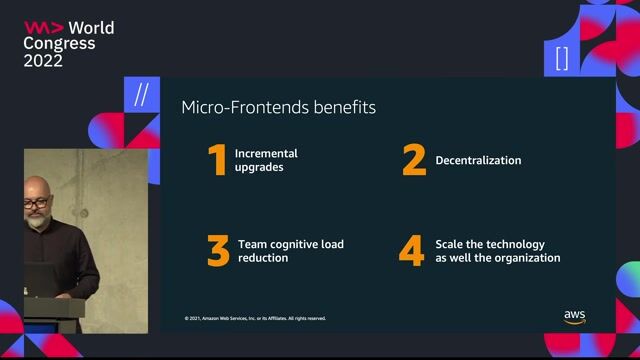
Understanding the key benefits of micro-frontend architecture
Micro-frontends enable incremental upgrades, decentralized decision-making, and reduced team cognitive load by aligning architecture with organizational structure.
#3about 4 minutes
Differentiating between domain-aware micro-frontends and components
A micro-frontend represents a business subdomain and is independent, whereas a component is a reusable UI element configured by its container.
#4about 3 minutes
Avoiding the multi-framework trap in micro-frontends
Using multiple UI frameworks should be a temporary strategy for specific scenarios like legacy migration or company acquisitions, not a default choice.
#5about 4 minutes
Using an anti-corruption layer for legacy system integration
When integrating a legacy system, use an anti-corruption layer like an iframe to isolate it and translate its communication patterns, preventing contamination of the main application.
#6about 5 minutes
Managing the complexity and risk of shared libraries
Shared libraries create tight coupling and versioning challenges, so prefer duplication over premature abstraction and use dependency injection for necessary sharing.
#7about 3 minutes
Adopting unidirectional data flow for better debugging
Bidirectional data flow between a host and remote micro-frontend creates complexity, while a unidirectional flow simplifies debugging and reduces errors.
#8about 3 minutes
Preventing organizational coupling caused by shared global state
Sharing a global state across micro-frontends couples development teams together, so use loosely coupled communication methods like an event emitter instead.
#9about 3 minutes
Avoiding self-inflicted load by consolidating API calls
Having multiple micro-frontends call the same API endpoint creates unnecessary backend load, so consolidate these calls into a single parent micro-frontend or component.
#10about 1 minute
Recognizing that architectural decisions are context-dependent trade-offs
There are no universally right or wrong architectural choices, as the validity of a pattern depends entirely on the specific project context and organizational needs.
#11about 13 minutes
Audience Q&A on practical micro-frontend challenges
The speaker answers audience questions on topics including using iframes, splitting monoliths, designing for future scalability, and comparing composition tools.
Related jobs
Jobs that call for the skills explored in this talk.
Matching moments
03:57 MIN
Anti-pattern: Analyzing the backend impact of frontend architecture
Micro-frontends anti-patterns
04:52 MIN
Anti-pattern: Confusing micro-frontends with reusable components
Micro-frontends anti-patterns
04:34 MIN
Conclusion and key takeaways on micro frontends
Micro Frontends with Module Federation: Why and How?
08:02 MIN
Combining micro frontends with an islands architecture
Multiple Ships to the Island - Micro Frontends & Island Architectures
06:11 MIN
Tracing the architectural evolution to microfrontends
Microfrontends with Blazor: Welcome to the Party!
02:43 MIN
Common challenges and implementation drawbacks
Micro Frontends with Module Federation: Why and How?
04:32 MIN
Introduction to JavaScript design patterns
10 must-know design patterns for JS Devs
02:03 MIN
Introducing the micro-frontend architectural pattern
Destructuring Frontend monoliths with MicroFrontends
Why You Shouldn’t Build a Microservice ArchitectureWelcome to this issue of the WeAreDevelopers Live Talk series. This article recaps an interesting talk by Michael Eisenbart who talks about the pros and cons of microservice architecture.About the speaker:Michael has been working for Bosch as a sof...
Chris Heilmann
Micro Components - a different approach to a simpler component-based webThere has been a lot of heated discussion lately in the web community about component based development. One side argued that Web Components are a standard we should follow whereas others complained that they still lag behind in what frameworks offer...
Chris Heilmann
All the videos of Halfstack London 2024!Last month was Halfstack London, a conference about the web, JavaScript and half a dozen other things. We were there to deliver a talk, but also to record all the sessions and we're happy to share them with you. It took a bit as we had to wait for th...
Luis Minvielle
The Best 7 Frontend Frameworks for Developers in 2025Which frontend frameworks should developers focus on in 2025? We’re listing them for you and showing advantages and drawbacks. You’ll notice we included some libraries as well, because you can’t miss those in 2025.What is the best front end framework...
From learning to earning
Jobs that call for the skills explored in this talk.





.gif?w=240&auto=compress,format)