Using code generation for test automation – the fancy way
What if refactoring your API created a compile error instead of a runtime failure? Learn a powerful code generation strategy for safer, faster API tests.
#1about 3 minutes
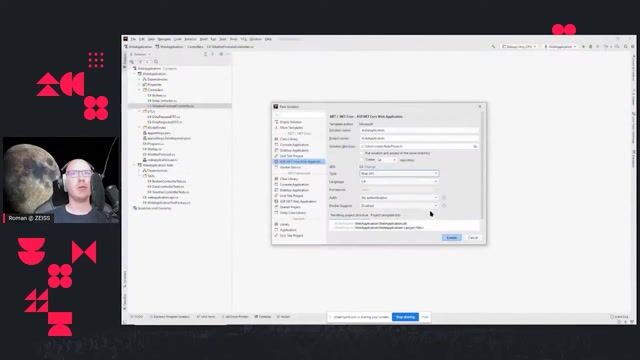
Setting up NSwag for OpenAPI documentation in .NET
Replace the default Swashbuckle with NSwag to generate OpenAPI specifications for a new .NET web application.
#2about 3 minutes
Automating swagger.json generation on every build
Configure the project file to automatically run the NSwag command-line tool after each build to create an up-to-date swagger.json file.
#3about 4 minutes
Generating a typed C# client for the test project
Use the generated swagger.json file to automatically create a strongly-typed C# HTTP client within the test project.
#4about 4 minutes
Using the generated client for robust API-level tests
Write API-level tests that consume the generated client, ensuring that any API signature changes result in compile-time errors.
#5about 7 minutes
Testing DTOs, validation, and API error handling
Leverage the generated client and DTOs to easily test complex validation rules, serialization formats, and API exception handling.
#6about 4 minutes
Achieving high test coverage with API-level tests
Focusing on API-level tests provides high code coverage and confidence for refactoring while reducing the effort spent on traditional unit tests.
#7about 2 minutes
Key lessons learned from this testing approach
This approach requires writing precise controller code and evolving from slow Docker-based databases to faster in-memory databases for tests.
#8about 1 minute
Q&A: Why API tests can be more efficient than unit tests
API-level tests reduce the developer time spent writing and maintaining numerous small unit tests, especially as the codebase grows.
#9about 1 minute
Q&A: Managing code coverage targets and exceptions
Set a high but realistic code coverage target like 90-95% to avoid writing useless tests for unreachable edge cases.
#10about 2 minutes
Q&A: Automating checks for breaking API changes
A potential improvement is to add a CI step that tests the new API version against a client generated from a previous API version.
#11about 2 minutes
Q&A: Managing test state and database setup
Use the web application factory to manage test setup, such as spinning up an in-memory database and seeding it with data for each test class.
#12about 2 minutes
Q&A: Mocking external service dependencies in tests
Isolate the API under test by mocking external service calls through interfaces, reserving full integration tests for the CI pipeline.
#13about 3 minutes
Q&A: The accidental discovery of this testing workflow
The idea to use the generated client in tests originated from the initial goal of providing an easy-to-use client for other consumer APIs.
Related jobs
Jobs that call for the skills explored in this talk.
Matching moments
01:26 MIN
Moving from manual unit testing to automated generation
Are you still programming unit tests or already generating?
03:33 MIN
Demo of automating unit test generation and validation
Rethinking Workflows in the Agentic Era
06:44 MIN
Generating code from specifications with modern tooling
Specifications as the better way of software development
04:01 MIN
How AI is changing test generation and maintenance
The 2025 State of JavaScript Testing
04:09 MIN
Using automation as a catalyst for team collaboration
How to add test automation to your project: The good, the bad, and the ugly
03:40 MIN
Accelerating development by generating various types of tests
GitHub Copilot Beyond the Basics - 10 Ways to Elevate Your Coding
03:58 MIN
Leveraging automation as a gift for development workflows
Unlocking Seamless Collaboration: Design-First APIs for UI Components
How we Build The Software of TomorrowWelcome to this issue of the WeAreDevelopers Live Talk series. This article recaps an interesting talk by Thomas Dohmke who introduced us to the future of AI – coding.This is how Thomas describes himself:I am the CEO of GitHub and drive the company’s...
Daniel Cranney
How to Use Generative AI to Accelerate Learning to CodeIt’s undeniable that generative-AI and LLMs have transformed how developers work. Hours of hunting Stack Overflow can be avoided by asking your AI-code assistant, multi-file context can be fed to the AI from inside your IDE, and applications can be b...