Your model works in training, but what about production? Learn how MLOps prevents model degradation and turns experiments into reliable, continuously monitored systems.
#1about 4 minutes
Defining MLOps and its role in production ML
MLOps is introduced as the DevOps equivalent for machine learning, addressing common failure points like duplicated effort, lack of reproducibility, and poor monitoring.
#2about 4 minutes
How ML development differs from software engineering
Machine learning development is an iterative, experimental process where most attempts fail, unlike the more linear and predictable workflow of traditional software engineering.
#3about 8 minutes
Building versioned data pipelines with feature stores
A centralized feature store and versioned data pipelines prevent duplicated work and ensure consistency between training and production environments.
#4about 6 minutes
Using experiment tracking and model registries for reproducibility
An experiment tracker captures metadata, parameters, and results, while a model registry versions the trained models to ensure full reproducibility.
#5about 4 minutes
Exploring central server and edge deployment options
Models can be deployed on a central server via an API for scalability or on edge devices to improve privacy and reduce latency.
#6about 6 minutes
Monitoring model performance and handling concept drift
Continuously monitoring model inputs, outputs, and confidence scores is crucial for detecting performance degradation due to concept drift and enabling retraining.
#7about 5 minutes
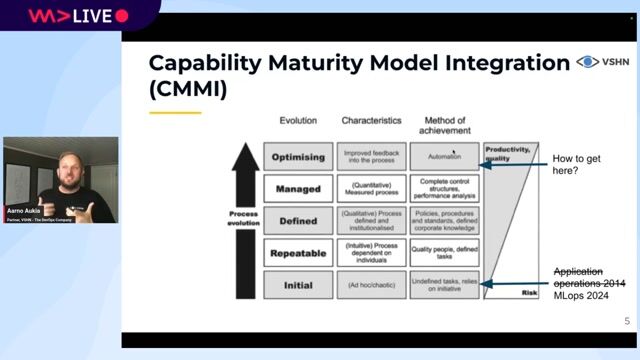
Adopting MLOps with an evolutionary, team-based approach
Successful MLOps implementation requires an incremental adoption strategy and cross-functional teams where data scientists and software engineers collaborate closely.
#8about 6 minutes
Q&A on parallel computing, data versioning, and security
The Q&A session addresses using tools like Argo for parallel processing, strategies for versioning large datasets, and handling malicious user feedback in active learning systems.
Related jobs
Jobs that call for the skills explored in this talk.
Matching moments
01:33 MIN
The convergence of ML and DevOps in MLOps
AI Model Management Life Circles: ML Ops For Generative AI Models From Research to Deployment
03:08 MIN
Understanding the role and challenges of MLOps
The Road to MLOps: How Verivox Transitioned to AWS
02:50 MIN
Understanding the core principles and lifecycle of MLOps
MLOps on Kubernetes: Exploring Argo Workflows
04:56 MIN
What MLOps is and the engineering challenges it solves
MLOps - What’s the deal behind it?
02:36 MIN
Applying DevOps principles to machine learning operations
DevOps for AI: running LLMs in production with Kubernetes and KubeFlow
10:42 MIN
Understanding the machine learning workflow and MLOps
MLops – Deploying, Maintaining And Evolving Machine Learning Models in ProductionWelcome to this issue of the WeAreDevelopers Live Talk series. This article recaps an interesting talk by Bas Geerdink who gave advice on MLOps.About the speaker:Bas is a programmer, scientist, and IT manager. At ING, he is responsible for the Fast...
Benedikt Bischof
MLOps – What’s the deal behind it?Welcome to this issue of the WeAreDevelopers Live Talk series. This article recaps an interesting talk by Nico Axtmann who introduced us to MLOpsAbout the speaker:Nico Axtmann is a seasoned machine learning veteran. Starting back in 2014 he observed ...
Benedikt Bischof
MLOps And AI Driven DevelopmentWelcome to this issue of the WeAreDevelopers Dev Talk Recap series. This article recaps an interesting talk by Natalie Pistunovic who spoke about the development of AI and MLOps. What you will learn:How the concept of AI became an academic field and ...
Dilek Demir
Data Science & more: The Lopez dilemmaCatwalk, Data Science, Hollywood, Google Images, Haute Couture, StackOverflow, Comfort Zone, Dota 2 and Versace – all these topics are connected and influenced by each other. Read here how and why!In 2000 Jennifer Lopez's green Versace dress went vi...
From learning to earning
Jobs that call for the skills explored in this talk.









.gif?w=240&auto=compress,format)
.gif?w=240&auto=compress,format)
.gif?w=240&auto=compress,format)