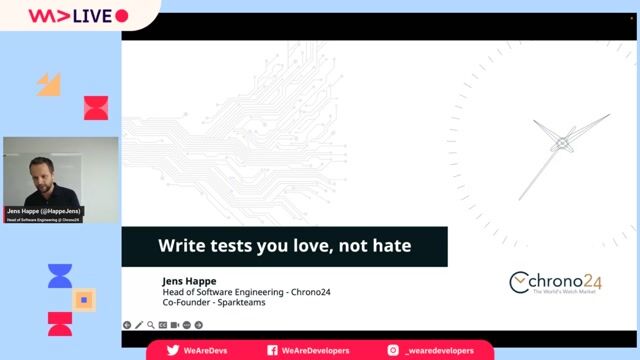
What if the secret to better application architecture wasn't design patterns, but simply writing testable code?
#1about 3 minutes
How unit testing helps overcome early programming struggles
Unit testing provides quick feedback and encourages better code structure, making it easier for new programmers to understand and debug their work.
#2about 2 minutes
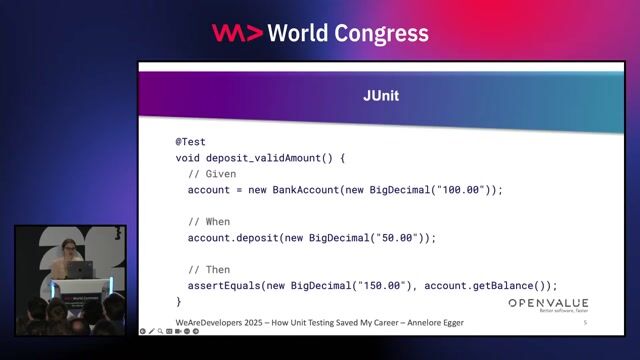
Structuring clear and simple unit tests
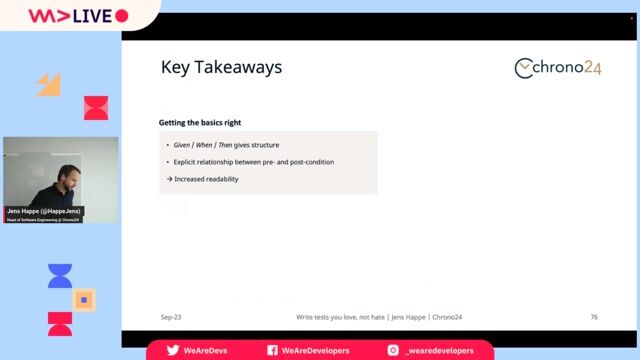
Adopting a consistent structure like "Given-When-Then" and using descriptive method names makes tests easier to understand and maintain.
#3about 4 minutes
How writing testable code leads to cleaner code
Refactoring a monolithic method into smaller, testable units naturally improves code readability, maintainability, and overall quality.
#4about 2 minutes
Using test-driven development to guide implementation
Test-driven development (TDD) forces you to think about requirements first, leading to more structured code and serving as a form of documentation.
#5about 3 minutes
Isolating dependencies with mocking frameworks like Mockito
Mocking frameworks like Mockito allow you to isolate the unit under test by replacing external dependencies with controlled mock objects.
#6about 3 minutes
The vicious cycle of untestable legacy code
A lack of tests in legacy code creates a vicious cycle where developers fear refactoring, leading to worse code that is even harder to test.
#7about 3 minutes
Using parameterized tests for efficient test coverage
Parameterized tests in JUnit allow you to run a single test method with multiple input values, simplifying the process of covering various scenarios and edge cases.
#8about 3 minutes
Challenging and simplifying complex test setups
When faced with a complex test setup, challenge its necessity by asking why it exists and explore simplifying it by improving code testability or using mocks.
#9about 2 minutes
Understanding the test pyramid and single responsibility
The test pyramid guides the ratio of unit, integration, and end-to-end tests, with units being small pieces of code that adhere to the single responsibility principle.
#10about 1 minute
Final thoughts on unit testing as a developer's tool
Treat unit tests as a valuable development tool, and if they become a source of friction, investigate and challenge the underlying code or test setup complexity.
Related jobs
Jobs that call for the skills explored in this talk.
Matching moments
03:00 MIN
Summary of key principles for better testing
Write tests you love, not hate
01:57 MIN
Why developers often view unit testing as a chore
Test-reduction - Doing more with less
07:27 MIN
Why developers avoid unit testing JavaScript
Yes, You Need to Unit Test your JavaScript. Here's How.
01:41 MIN
Why good tests enable confident refactoring and speed
TDD for Vue.js Developers
02:01 MIN
Excellent testing is fast, credible, and accountable
Excellent Software Testing
01:54 MIN
Actionable steps to immediately improve your testing
Your Testing Strategy is broken - lets fix it!
03:10 MIN
Connecting dog training principles to software testing
Treat yourself - A tale about dog training and test-driven development
Integration And E2E Testing: Are They Complementary or Interchangeable?The coronavirus pandemic’s effect on the software development industry was not as devastating as for, say, arts and tourism. In fact, the industry demonstrated significant resilience. According to Statista, only about a third of IT specialists worldw...
Chris Heilmann
WWC24 Talk - Brenda Romero - Stay: Surviving and Thriving in TechBrenda Romero discusses her tech career journey, overcoming burnout, and inspiring future game developers at WWC24.Here is what she had to say in the video:Hey everyone! Thanks for joining us!Reflections on a Rough YearLast year, I gave a talk about ...
Kate Passby
How to create a test plan for software testingWhen creating new software, it's important to put it through rigorous testing. This improves IT security and helps to identify any problems. As software developers, the aim is to make the process of testing as painless as possible. This ensures the s...