Composable Intelligence: How Henkel and Microsoft Are Shaping the Agent Ecosystem
Standard chatbots can't tell the difference between gluing an airplane and paper. See how Henkel built a composable agent ecosystem that can.
#1about 5 minutes
Understanding Henkel's need for AI agent behavior
The vast scale of Henkel's product catalog across global markets creates complex knowledge management challenges that AI agents can help solve.
#2about 2 minutes
Differentiating AI agents from traditional chatbots
AI agents are defined by their ability to make semi-autonomous decisions, decompose problems, and proactively use memory and tools, unlike reactive chatbots.
#3about 2 minutes
How Henkel and Microsoft collaborate on AI innovation
The partnership combines Microsoft's technology push with Henkel's market pull to identify valuable business problems and co-develop innovative AI solutions.
#4about 3 minutes
Core principles for building a composable agent platform
The platform is built on principles of governed autonomy, composability, distributed architecture, and open standards to ensure flexibility and scalability.
#5about 4 minutes
Exploring the layered architecture of the RAQN platform
The RAQN platform architecture consists of a cloud foundation, core building blocks like workflow and memory, and an enablement layer focused on developer experience.
#6about 2 minutes
Overcoming challenges with context and complex data
Building effective agents requires moving beyond simple prompt engineering to systems that can integrate structured and unstructured data using knowledge graphs and memory.
#7about 2 minutes
Using open standards for agent interoperability
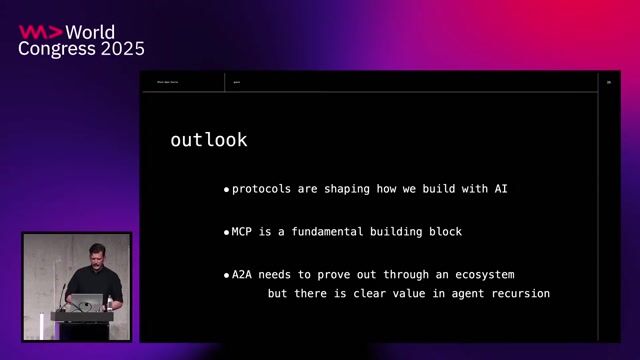
Open protocols like MCP for data, A2A for communication, and OIDC for identity are crucial for creating a discoverable and interoperable ecosystem of agents.
#8about 5 minutes
Applying distributed systems principles to AI agents
Proven software engineering practices like the 12-factor app methodology and resiliency patterns are adapted to build robust and scalable agent-based systems.
#9about 1 minute
Key learnings on data, frameworks, and user adoption
The primary challenges in deploying agent solutions are overcoming poor data quality, navigating immature frameworks, and aligning advanced capabilities with user expectations.
Related jobs
Jobs that call for the skills explored in this talk.
Matching moments
04:30 MIN
Assessing customer excitement and enterprise AI adoption
Architecting the Future: Leveraging AI, Cloud, and Data for Business Success
01:26 MIN
Exploring the Azure AI Foundry Agent Service
Agentic AI - From Theory to Practice: Developing Multi-Agent AI Systems on Azure
16:49 MIN
Q&A on AI adoption, tools, and challenges
Navigating the AI Wave in DevOps
02:40 MIN
Key takeaways for implementing AI agent solutions
Infrastructure as Prompts: Creating Azure Infrastructure with AI Agents
01:20 MIN
The future of AI protocols and agent ecosystems
From A2A to MCP: How AI’s “Brains” are Connecting to “Arms and Legs”
02:32 MIN
Future outlook on AI agents and open standards
Exploring AI: Opportunities and Risks in Development
03:22 MIN
How AI agents can accelerate infrastructure deployment
Infrastructure as Prompts: Creating Azure Infrastructure with AI Agents
07:19 MIN
Demo of an agentic system for Azure architecture design
Panel Discussion: Responsible AI in Practice - Real-World Examples and ChallengesIntroductionIn the ever-evolving landscape of artificial intelligence, the concept of "responsible AI" has emerged as a cornerstone for ethical and practical AI implementation. During the WWC24 Panel discussion, three eminent experts—Mina, Bjorn Brin...
Daniel Cranney
Stephan Gillich - Bringing AI EverywhereIn the ever-evolving world of technology, AI continues to be the frontier for innovation and transformation. Stephan Gillich, from the AI Center of Excellence at Intel, dove into the subject in a recent session titled "Bringing AI Everywhere," sheddi...
Chris Heilmann
WWC24 Talk - Scott Hanselman - AI: Superhero or Supervillain?Join Scott Hanselman at WWC24 to explore AI's role as a superhero or supervillain. Scott shares his 32 years of experience in software engineering, discusses AI myths, ethical dilemmas, and tech advancements. Engage with his live demos and insights o...