You don't need complex tools to start with RAG. This session builds a surprisingly effective system from scratch using basic vectorization and cosine similarity.
#1about 3 minutes
Why large language models need retrieval augmented generation
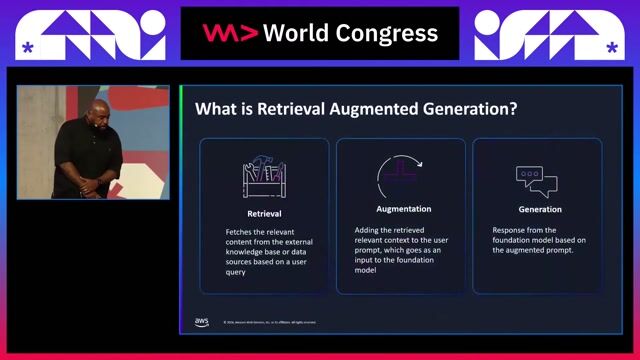
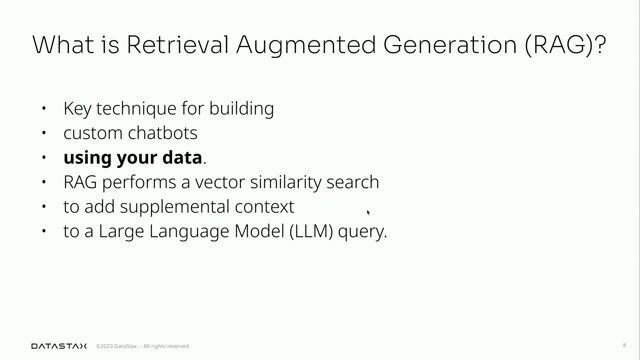
Large language models have knowledge cutoffs and lack access to private data, a problem solved by providing relevant context at query time using RAG.
#2about 1 minute
How similarity search and vector embeddings power RAG
RAG relies on similarity search, not keyword search, which captures meaning by converting text into numerical representations called vector embeddings.
#3about 6 minutes
Building a simple bag-of-words vectorizer from scratch
A basic vector embedding can be created by tokenizing text, building a vocabulary of unique words, and representing each document as a vector of word counts.
#4about 8 minutes
Comparing document vectors using cosine similarity
Cosine similarity measures the angle between two vectors to determine their semantic closeness by focusing on direction (meaning) rather than magnitude.
#5about 3 minutes
Understanding the limitations of a bag-of-words model
The simple bag-of-words model is sensitive to vocabulary, slow to scale, and fails to capture nuanced semantic meaning like word order or synonyms.
#6about 4 minutes
Using professional embedding models and vector databases
Production RAG systems use sophisticated embedding models and specialized vector databases for efficient, accurate, and scalable similarity search.
#7about 2 minutes
Exploring advanced RAG techniques and other applications
Beyond basic similarity search, techniques like ColBERT and knowledge graphs can improve retrieval accuracy, and vector search can power features like related content recommendations.
Related jobs
Jobs that call for the skills explored in this talk.
Matching moments
03:45 MIN
Understanding retrieval-augmented generation systems
AI Model Management Life Circles: ML Ops For Generative AI Models From Research to Deployment
02:42 MIN
Powering real-time AI with retrieval augmented generation
Scrape, Train, Predict: The Lifecycle of Data for AI Applications
How to Use Generative AI to Accelerate Learning to CodeIt’s undeniable that generative-AI and LLMs have transformed how developers work. Hours of hunting Stack Overflow can be avoided by asking your AI-code assistant, multi-file context can be fed to the AI from inside your IDE, and applications can be b...
Daniel Cranney
Panel Discussion: Responsible AI in Practice - Real-World Examples and ChallengesIntroductionIn the ever-evolving landscape of artificial intelligence, the concept of "responsible AI" has emerged as a cornerstone for ethical and practical AI implementation. During the WWC24 Panel discussion, three eminent experts—Mina, Bjorn Brin...
Daniel Cranney
Stephan Gillich - Bringing AI EverywhereIn the ever-evolving world of technology, AI continues to be the frontier for innovation and transformation. Stephan Gillich, from the AI Center of Excellence at Intel, dove into the subject in a recent session titled "Bringing AI Everywhere," sheddi...
Eli McGarvie
16 Ways Developers Can Use ChatGPT-4 and GPT-4oChatGPT has been busy getting new designations. If you’ve been scrolling on 𝕏 over the last week, then you’ve seen the ChatGPT-4o announcement and probably thought of Joaquin Phoenix’s virtual girlfriend on Her.Beyond the references to flicks, the la...
From learning to earning
Jobs that call for the skills explored in this talk.