Why Iterators Got It All Wrong — and what we should use instead
C++ iterators are broken by design. Their ambiguity creates subtle bugs with modern ranges. It's time for a safer, more explicit model.
#1about 1 minute
The dual role of C++ iterators as elements and borders
C++ iterators, modeled after pointers, are used ambiguously to represent both specific elements and the borders between them.
#2about 1 minute
Writing cleaner code with C++ ranges
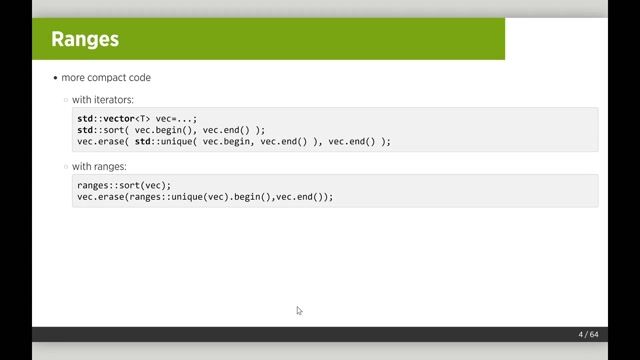
C++20 ranges simplify code by reducing the boilerplate of begin() and end() calls required with traditional iterator pairs.
#3about 4 minutes
Using range adapters for lazy transformations
Range adapters like transform allow for lazy evaluation, separating data projection from the search operation for more modular code.
#4about 2 minutes
How filter adapters create ambiguity for borders
The filter adapter demonstrates a flaw where mapping a border from a filtered range back to the original range is ambiguous.
#5about 5 minutes
The core problem with the reverse adapter
The reverse adapter proves that a single .base() method cannot correctly map both elements and borders back to the original range.
#6about 3 minutes
A formal solution with element and border concepts
The fundamental iterator flaw can be solved by introducing two distinct concepts: 'border' for positions between items and 'element' for the items themselves.
#7about 4 minutes
Improving algorithms with nullable elements and better names
Further improvements include making element types nullable to handle 'not found' cases cleanly and using more descriptive algorithm names like binary_find.
#8about 2 minutes
Conclusion and the think-cell range library
The think-cell C++ range library implements concepts like nullable elements and refined algorithms to address the inherent flaws in standard iterators.
#9about 4 minutes
Q&A on iterator invalidation and border types
The speaker addresses audience questions regarding how the border and element distinction interacts with container iterator invalidation and mathematical open or closed intervals.
Related jobs
Jobs that call for the skills explored in this talk.
Matching moments
08:00 MIN
Solving complex problems with advanced range adaptors
Functional Programming in C++
04:08 MIN
Building lazy data pipelines with C++20 ranges and views
Functional Programming in C++
07:25 MIN
Core design principles and the language evolution trilemma
The Design and Evolution of C++
06:50 MIN
C++ availability, ecosystem, and backwards compatibility
101 brilliant things of C++
04:19 MIN
Processing large datasets with the iterator pattern and streams
10 must-know design patterns for JS Devs
05:24 MIN
Debunking common myths about C++ in constrained systems
C++ in constrained environments
06:45 MIN
Writing reusable code with generic programming and templates
How we Build The Software of TomorrowWelcome to this issue of the WeAreDevelopers Live Talk series. This article recaps an interesting talk by Thomas Dohmke who introduced us to the future of AI – coding.This is how Thomas describes himself:I am the CEO of GitHub and drive the company’s...
Daniel Cranney
The State of HTML 2024: What can we learn from it?The results of the State of HTML 2024 survey are in! Though the name suggests it’s HTML-only, the survey focuses on the web platform in a more general sense, giving us some fascinating insights into not only the state of the web, but also some sense ...
Chris Heilmann
Dev Digest 131 - AI'm not sure about OSSNews and ArticlesRust and Typescript are rising stars in programming languages 2024 survey, the State of CSS 2024 survey is open and here is what's new in ECMAScript.In security news, a Microsoft update bricks Linux dual-boot systems, they patched a ...
From learning to earning
Jobs that call for the skills explored in this talk.