The hardest part of building a voice AI isn't the AI. It's making all the tools work together in real-time. Here's the complete blueprint.
#1about 1 minute
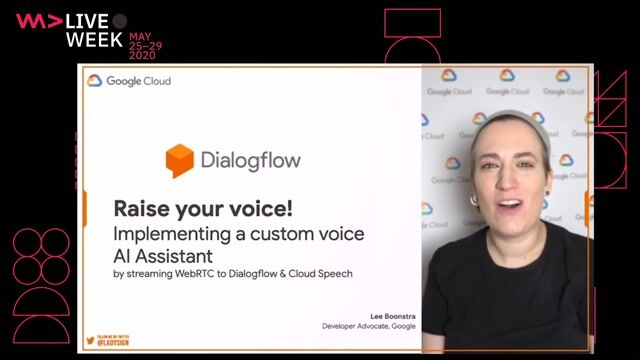
Building a custom voice AI with WebRTC and Google APIs
An overview of the architecture for streaming voice from a browser to a backend for processing with conversational AI.
#2about 4 minutes
Comparing custom voice AI to public assistants
A custom voice AI provides more control over technical requirements and terms of service compared to public platforms like Google Assistant or Alexa.
#3about 1 minute
Handling short versus long user utterances
Public assistants are optimized for short commands, whereas custom AI for use cases like contact centers must be designed to handle long, complex user stories.
#4about 3 minutes
Demo of a voice-enabled self-service kiosk
A demonstration of a web-based airport kiosk that answers user questions spoken in different languages using a custom voice AI.
#5about 1 minute
The core challenge of integrating voice technologies
The main difficulty in building a voice AI is not using individual APIs, but integrating the entire pipeline from frontend audio stream to backend processing.
#6about 3 minutes
Capturing cross-browser microphone audio with RecordRTC
The RecordRTC library is used to abstract away browser inconsistencies and reliably capture microphone audio streams for processing.
#7about 2 minutes
Streaming audio to the backend with Socket.IO
Socket.IO and the socket.io-stream module enable real-time, bidirectional streaming of binary audio data from the browser to a Node.js backend.
#8about 3 minutes
Transcribing audio with the Speech-to-Text API
Google's Speech-to-Text API converts the incoming audio stream into text using a streaming recognition call that handles data as it arrives.
#9about 4 minutes
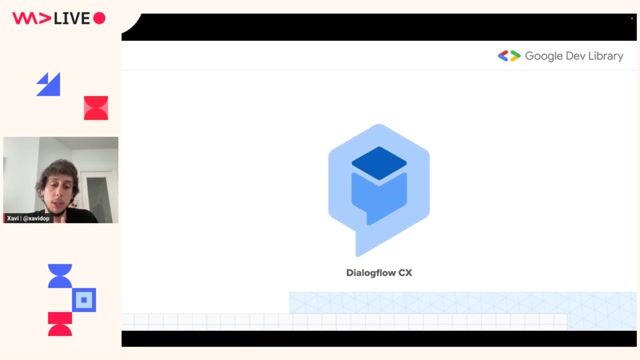
Understanding user intent with Dialogflow
Dialogflow uses natural language understanding to match transcribed user text to predefined intents, entities, and knowledge bases to determine the user's goal.
#10about 4 minutes
Adding multi-language support with the Translate API
The Translate API enables multi-language support by translating foreign language input to English for Dialogflow processing and then translating the response back.
#11about 3 minutes
Generating audio responses with Text-to-Speech
The Text-to-Speech API synthesizes a natural-sounding voice from the text response, which is then sent back to the browser as an audio buffer to be played.
#12about 1 minute
Deployment considerations and open source code
Deploying a voice application requires HTTPS for microphone access, which can be easily configured using services like App Engine Flex, and the full project code is available on GitHub.
Related jobs
Jobs that call for the skills explored in this talk.
Matching moments
02:20 MIN
Using AI for a conversational developer experience
Platform Engineering untold truths: is just an infrastructure matter?
03:23 MIN
Building real-time conversational agents
Prompt API & WebNN: The AI Revolution Right in Your Browser
04:16 MIN
Democratizing software development with natural language
Agents for the Sake of Happiness
01:26 MIN
Live demo of the AI-powered translation application
Rust and Docker: Let's build an AI-powered app!
03:56 MIN
Practical use cases for on-device AI
Prompt API & WebNN: The AI Revolution Right in Your Browser
04:47 MIN
Why natural voice AI has been so difficult
Hello JARVIS - Building Voice Interfaces for Your LLMS
04:28 MIN
A software developer's perspective on building AI prototypes
Bringing the power of AI to your application.
02:47 MIN
Developing the bot's technical and conversational framework
13 AI Tools You Have to TryFirst, it was NFTs, then it was Web3, and now it’s generative AI… it’s probably time to stop collecting pictures of monkeys and kitties. Chatbots and generative AI are the next big thing. This time we’ve jumped on a trend that has real-world applicat...
Panel Discussion: Responsible AI in Practice - Real-World Examples and ChallengesIntroductionIn the ever-evolving landscape of artificial intelligence, the concept of "responsible AI" has emerged as a cornerstone for ethical and practical AI implementation. During the WWC24 Panel discussion, three eminent experts—Mina, Bjorn Brin...
Chris Heilmann
Exploring AI: Opportunities and Risks for DevelopersIn today's rapidly evolving tech landscape, the integration of Artificial Intelligence (AI) in development presents both exciting opportunities and notable risks. This dynamic was the focus of a recent panel discussion featuring industry experts Kent...
From learning to earning
Jobs that call for the skills explored in this talk.